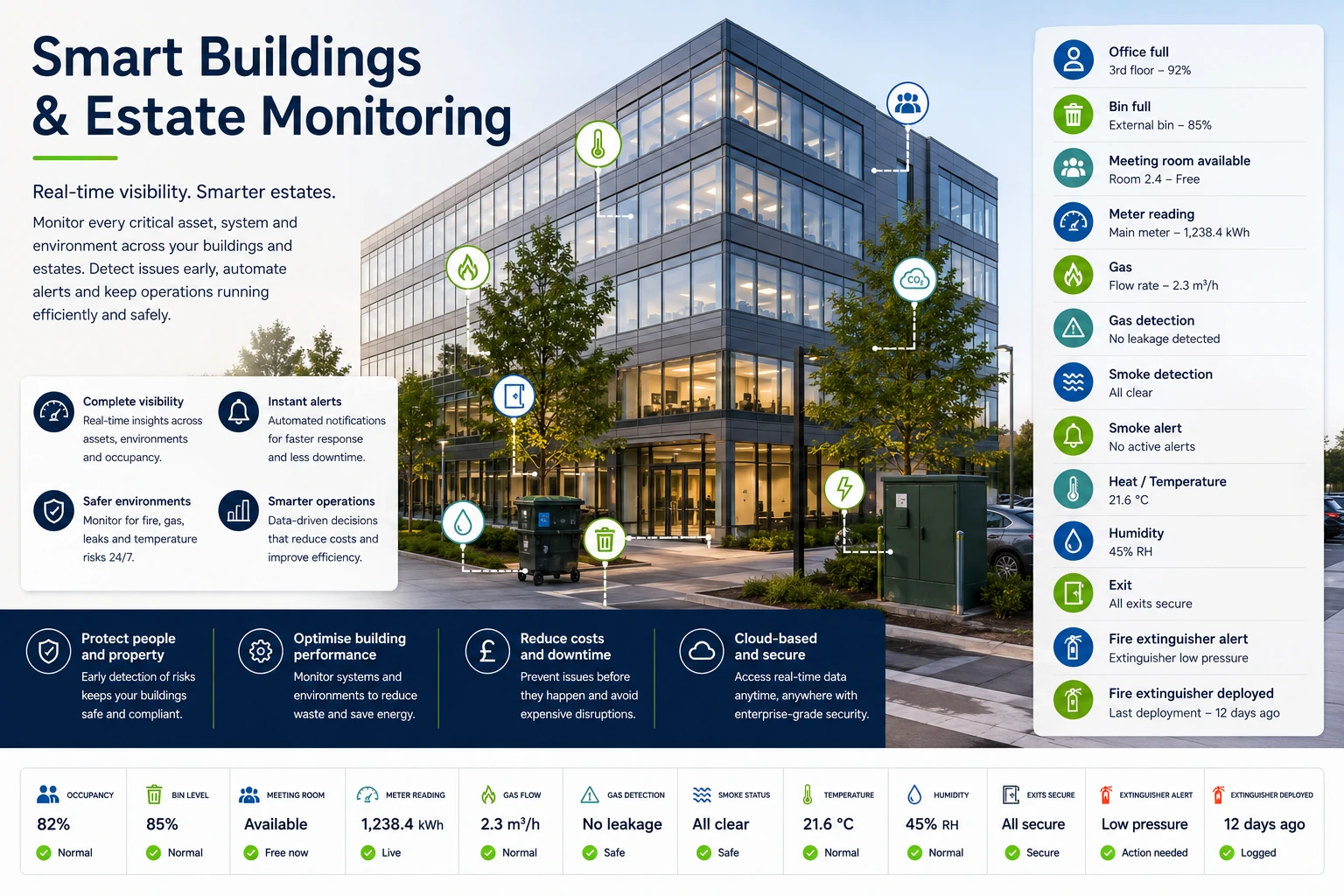
Buildings and estates generate risk in the gaps between inspections. A practical IoT layer makes access, environmental and asset-state changes visible before they turn into downtime, damage or reactive attendance.
Estate operators manage mixed portfolios across offices, residential blocks, industrial estates, public buildings, campuses and plant-heavy environments. Each site has its own access constraints, building fabric, contractor model, asset history and operational blind spots.
Traditional BMS and building tools only cover part of that reality. They may not reach every riser, basement, cabinet, valve, temporary plant area, perimeter gate, roof access point or remote building. A focused IoT layer can add useful monitoring where existing systems are absent, incomplete or too costly to extend.
The right system starts with the estate risk. That may be water ingress, thermal drift, humidity exposure, abnormal access, missing equipment, movement, tamper, utility conditions, plant-room state, environmental excursions or recurring contractor attendance. The goal is not to collect every signal. The goal is to surface the signals that change decisions.
Connectivity is designed around the building. Depending on construction, distance, shielding, payload, gateway position and available power, deployments may use 433 MHz, LoRaWAN-style profiles, cellular, Ethernet, Wi-Fi where appropriate or mixed gateway architectures.
Low-power deployment matters in estates. Many monitoring points sit in spaces where mains power is unavailable, cabling is disruptive or maintenance access is awkward. Battery devices, suitable reporting cadence and device-health visibility help keep the monitoring layer practical over time.
Exception signals keep teams focused. Environmental drift, water-risk events, unexpected access, movement, tamper, asset state changes, missed payloads, low battery and weak signal can be routed with severity, location, ownership and acknowledgement rather than becoming another noisy dashboard.
Evidence changes the conversation after an incident. A timeline of what changed, when it changed, who was alerted, whether the device and gateway were healthy and what response followed helps with incident review, contractor accountability, governance and insurer discussions.
Estate-wide monitoring is also a planning tool. Over time, repeated excursions, difficult spaces, recurring faults and response patterns show where preventive work is needed. That helps teams prioritise maintenance investment and reduce repeated reactive callouts.
The strongest deployments start with a representative pilot across different building types and risk profiles. We prove coverage, cadence, alert usefulness and evidence quality, then scale the pattern across more buildings, zones and operational stakeholders.