Thermal detection before heat becomes risk

Thermal detection and heat risk monitoring for plant rooms, electrical cupboards, comms rooms, enclosures, storage areas and distributed estates where early warning matters.

IoT Technologies designs heat-risk monitoring around operational response. The aim is to detect abnormal temperature rise, recurring hot spots and developing thermal conditions early enough for teams to act before downtime, damage or incident escalation.

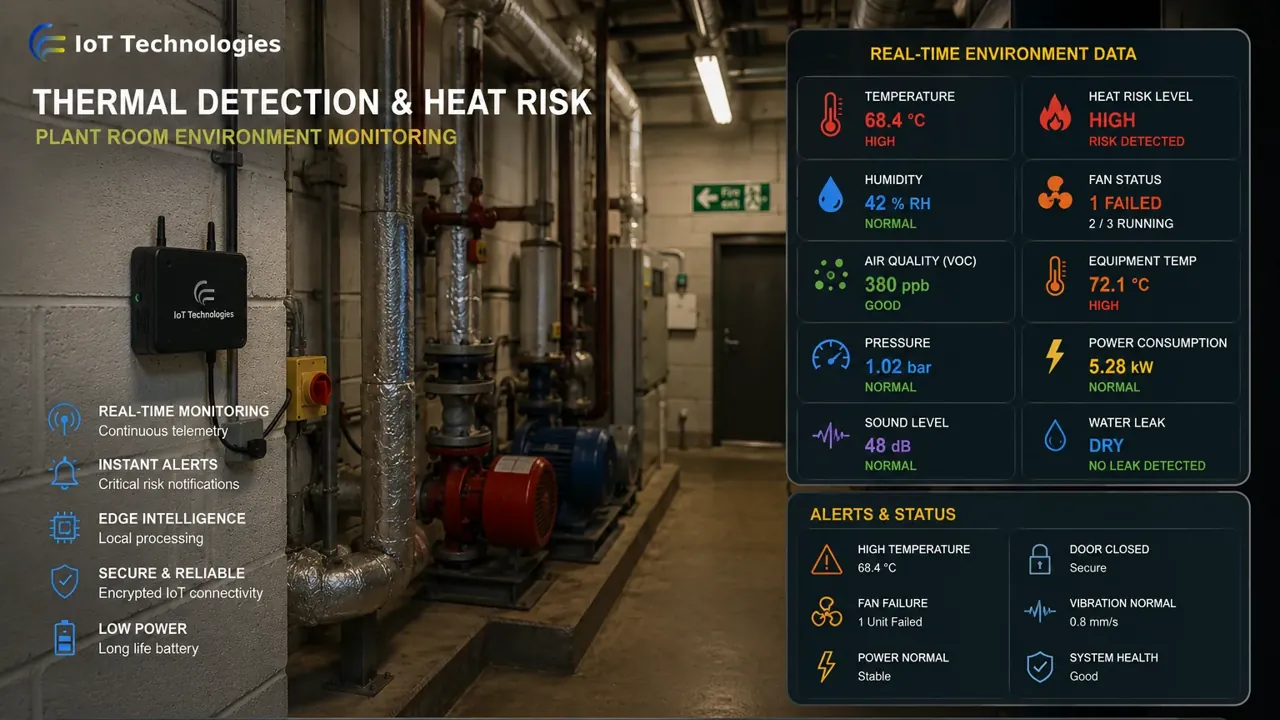
Illustrative thermal detection and heat risk dashboard showing temperature, heat risk level, fan status and equipment temperature in a plant room.

Early warning heat-risk monitoring

Detect abnormal heat before it becomes downtime, damage or incident escalation.

Heat-risk signals

Temperature rise, fast excursions, sustained breaches, recurring hot spots and trend patterns that indicate developing thermal risk.

433 MHz telemetry

Low-power RF telemetry can support compact long-life sensing in cupboards, plant spaces and hard-to-wire environments when survey confirms it is suitable.

Alert routing

Thresholds, severity, escalation and notification logic are shaped around the response team so alerts are clear and actionable.

Evidence trails

Time-aligned records help show when a condition changed, who was alerted and what response followed.

Thermal risk usually builds before it becomes visible. A practical monitoring system turns temperature rise, recurring hot spots and abnormal patterns into clear operational events.

Heat risk rarely appears as a single isolated moment. It builds through constrained airflow, overloaded equipment, poor ventilation, failing plant, seasonal conditions, temporary loads, blocked cupboards or changes in how a space is used. Manual checks and occasional inspections can miss the point where conditions begin to drift, especially across distributed estates and hard-to-access locations.

IoT Technologies designs thermal detection around the places where failure starts. Plant rooms, risers, electrical cupboards, battery spaces, comms rooms, storage areas and temporary works can all carry heat risk without being watched continuously. The monitoring plan should match the space, the asset, the likely failure mode and the response workflow, not just place a temperature sensor in the nearest convenient location.

For many of these spaces, 433 MHz RF can be a strong practical option. It supports low-power telemetry from compact devices and can suit building environments where Wi-Fi is unreliable, unavailable or undesirable. Used properly, 433 MHz can help sensors report threshold events, temperature trends and state changes from cupboards, enclosures, basements and plant areas without depending on local network infrastructure. It is not magic and it still needs survey, antenna planning and commissioning, but it gives us a useful tool for long-life sensing in difficult sites.

The system should be tuned to action. A slow temperature drift may need early warning before a threshold breach. A fast excursion may need immediate escalation. A recurring hot spot may point to an underlying issue that maintenance teams need to investigate. Alerts, dashboards and reports must therefore explain the risk clearly enough for teams to respond with confidence.

Thermal detection is also an evidence problem. When a condition changes, teams often need to prove when it started, how long it lasted, who was alerted and what happened next. Clean event histories support internal review, insurer conversations, safety workflows and post-incident analysis without relying on memory or scattered manual notes.

01

Thermal drift

Spot developing heat risk before a hard failure.

Monitor gradual rise, recurring threshold breaches and abnormal thermal patterns across rooms, cupboards, enclosures and equipment spaces so teams can intervene before damage or downtime occurs.

02

433 MHz sensing

Use low-power RF where Wi-Fi-dependent monitoring is the wrong fit.

433 MHz sensors can be useful for compact, long-life reporting in difficult spaces such as risers, cupboards, basements and plant rooms. We still survey the site properly, because RF performance depends on structure, placement, antenna design and surrounding interference.

03

Critical spaces

Protect comms rooms, plant rooms and electrical enclosures.

Thermal risk in operational spaces can affect uptime, equipment life, safety and service continuity. Monitoring creates earlier warning when local heat load, airflow or equipment behaviour starts to move outside normal conditions.

04

Alert quality

Turn heat events into action, not alarm fatigue.

We tune rules so the system distinguishes slow drift, urgent excursions and repeated local hot spots. The right alert should reach the right team with enough context to decide the next action.

05

Assurance

Create heat-risk records that stand up after the event.

When a thermal issue is reviewed later, teams need clear timelines. Event records, acknowledgement paths and escalation history support operational assurance, insurance conversations and post-incident learning.

Deployment approach

Survey the risk, then tune the detection around real site behaviour.

A good heat-risk deployment starts with the asset, the space and the failure mode, not the sensor catalogue.

We identify the thermal risk areas, survey power and RF conditions, place sensors where abnormal conditions begin, configure thresholds and escalation, prove the pilot against real site behaviour, then scale the model across additional spaces and estates.

Scope

Define the spaces, assets, thresholds, operating conditions, escalation owners and evidence requirements.

Define risk

Survey

Check placement, access, power options, RF behaviour, building materials, antenna constraints and maintenance realities.

Confirm signal

Configure

Set thermal thresholds, trend rules, alert severity, escalation paths and reporting views around the response workflow.

Tune response

Prove

Run a controlled pilot, validate sensor placement, check event quality and confirm that teams receive useful alerts.

Pilot evidence

Scale

Roll the proven pattern into more rooms, cabinets, plant areas and sites with consistent reporting and supportable maintenance.

Estate rollout

Bring the sites, heat-risk scenarios, target spaces and response workflow. We will shape the pilot around the conditions that actually matter.

Plan a thermal detection pilot

Applications

Where thermal detection reduces operational risk.

Plant rooms and risers

Monitor heat build-up, ventilation issues and repeated abnormal conditions in spaces that are often inspected infrequently.

Electrical cupboards and enclosures

Detect developing thermal risk around equipment, confined spaces and local hot spots before faults escalate.

Comms rooms and IT spaces

Track thermal conditions that can affect uptime, equipment life and response readiness across rooms that may not justify full building-management integration.

Storage and controlled spaces

Provide early warning and evidence where heat affects materials, stock, safety, quality or operating assurance.

Temporary works and site cabins

Deploy short-term heat-risk monitoring where permanent infrastructure is not justified but environmental control still matters.

Distributed estates

Create consistent thermal risk visibility across multiple buildings, rooms and remote spaces without depending on manual inspection cycles.

FAQ

Frequently asked questions

What is thermal detection and heat-risk monitoring?

It is low-power temperature sensing in plant rooms, electrical cupboards, comms rooms, enclosures and storage areas that detects abnormal temperature rise and recurring hot spots early enough for teams to act.

Is this a fire detection or fire alarm system?

No. It is an early-warning monitoring layer for developing thermal conditions, complementary to certified fire detection on a best-endeavours basis — it never replaces fire alarms or life-safety systems.

Where does heat risk usually develop?

Electrical cupboards, switchgear, dense cable runs, ageing equipment, enclosures and poorly ventilated spaces — places where a slow thermal climb goes unseen because nobody stands in front of them.

How quickly are abnormal temperatures alerted?

Readings are continuous, and threshold and trend rules raise an alert as soon as a space moves outside its expected behaviour, with routing and escalation configured around your response team.

Does it work in unmanned or hard-to-cable spaces?

Yes. Battery-powered sensors using sub-GHz radio at 433 MHz reach cupboards, enclosures and remote rooms without mains power, cabling or Wi-Fi.

Find thermal risk
before it becomes failure.

Share the spaces, assets, heat-risk scenarios and response workflow you need to monitor. We will help scope a practical pilot for thermal detection and estate heat-risk visibility.

Location

Aylsham Business Park, Norwich

Norfolk NR11 6FD · VAT GB 409644484

Thermal detection enquiry

Tell us where heat risk appears, what assets or spaces are affected, and how alerts should be routed when conditions move outside tolerance.

No mailing lists. No spam. We reply directly to your enquiry.