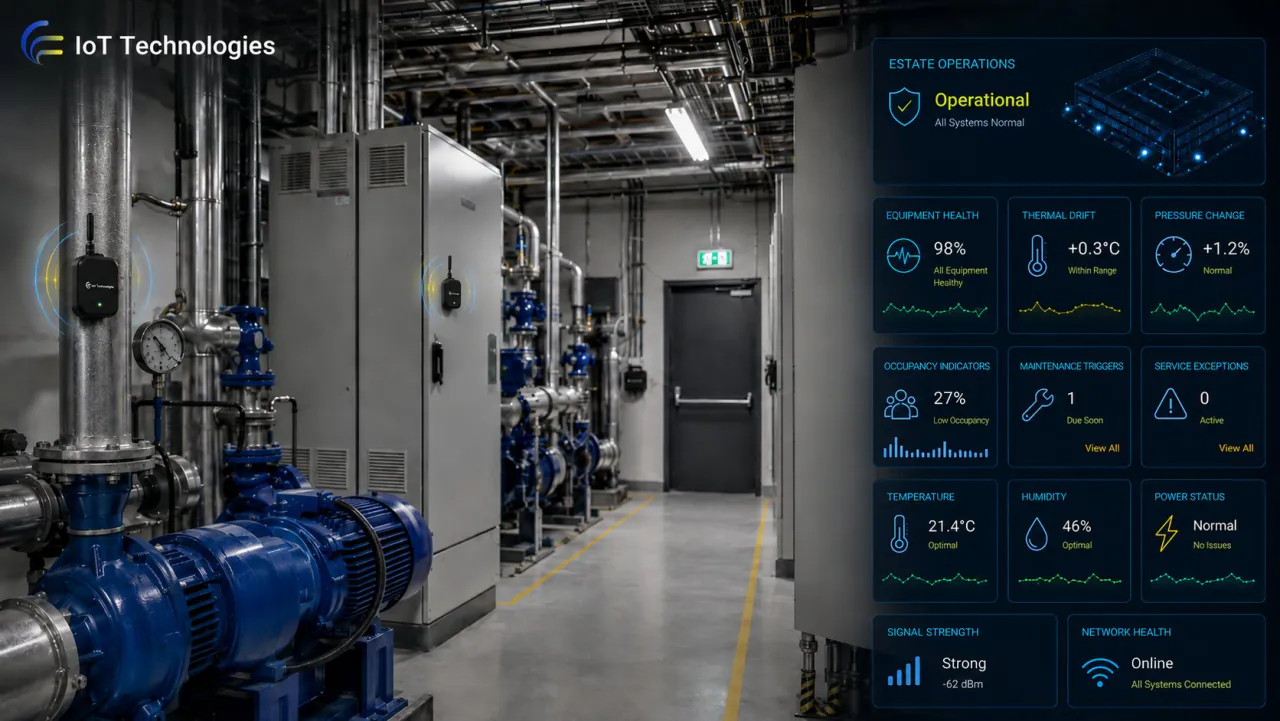
Estate operations fails when information is fragmented. Monitoring gives teams a live operational layer across the spaces, assets and workflows that manual checks cannot reliably control.
Large estates rarely fail because nobody cares. They fail because the signals are scattered. One system sees environmental conditions, another records alarms, contractors hold maintenance notes, engineers see local faults, and management only gets a clean view after the problem has already become expensive. The result is reactive attendance, repeated callouts, compliance stress and downtime that could often have been prevented with earlier warning.
IoT Technologies builds estate operations monitoring around the operational reality of distributed buildings, plant rooms, basements, cupboards, comms spaces, compounds and remote facilities. Some sites have poor Wi-Fi. Some are difficult to access. Some are served by contractors who need clear handover evidence before attending. Some need simple live visibility across many low-value signals rather than one expensive building-management project.
The estate layer should connect what matters: environmental excursions, plant-room conditions, asset state, gate or access events, equipment health, water-risk signals, thermal drift, pressure change, occupancy indicators, maintenance triggers and service exceptions. Not every site needs every signal. The correct design starts with the decisions your teams need to make and the evidence they need afterwards.
Real-time alerting is only useful when it is actionable. A facilities team does not need another noisy dashboard. They need clear severity, site context, asset or zone identity, escalation ownership and an acknowledgement trail. A critical event should trigger immediate action. A slow trend should surface before it becomes downtime. A recurring issue should become a maintenance priority instead of another hidden pattern.
Estate operations also lives or dies by handover. If a contractor attends site, they need context: what changed, when it started, whether it is recurring, what has already been checked and which evidence needs to be preserved. If a manager reviews an incident later, they need the same record in a defensible timeline. That is where IoT monitoring becomes more than sensors. It becomes an operating record.
Dashboards should serve different roles without creating confusion. Site teams need live exceptions and device health. Estate managers need portfolio views across buildings and regions. Compliance and assurance teams need event histories, response records and reporting outputs. Finance and leadership need visibility of repeated faults, wasted callouts and the places where preventive action will reduce cost.
Connectivity, power and access are designed into the deployment. Low-power sensing, gateway placement, 433 MHz or other RF options, Ethernet, cellular and site-specific connectivity can all be used where appropriate. The system is surveyed and commissioned around coverage, battery life, maintenance access and the reporting cadence needed for the workflow.
The best estate operations deployments start small and scale intelligently. A focused pilot can prove event quality, response routing, reporting value and operational adoption before expansion across the estate. Once the pattern is proven, the same framework can support buildings, field assets, contractors, remote locations and centralised reporting without forcing every site into the same rigid model.