Asset condition monitoring for plant, equipment and estates

Telemetry-led condition monitoring for assets that need early warning, maintenance prioritisation and evidence-led intervention before failure becomes expensive.

IoT Technologies designs asset condition monitoring systems around the asset, the site and the maintenance workflow, using practical sensors, reliable connectivity, useful alerts and dashboard records that help teams act.

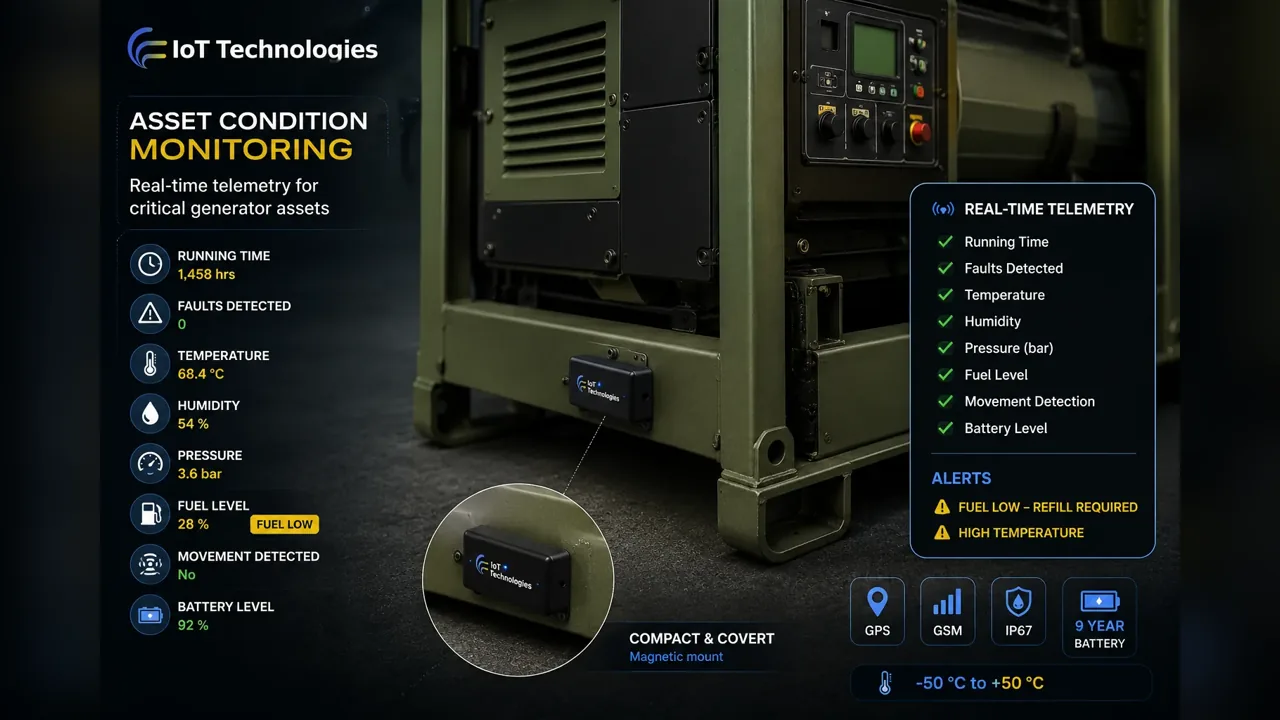
Illustrative asset condition monitoring dashboard showing running hours, temperature, pressure, fuel level and fault status on a generator asset.

What we deploy

Condition monitoring that turns early signals into maintenance action.

Early degradation detection

Monitor trend drift, recurring anomalies and asset-specific telemetry so teams can intervene before failure escalates.

Maintenance prioritisation

Use evidence from monitored assets to focus site visits, spares and contractor effort where risk is actually developing.

Useful alert routing

Configure thresholds, trend rules, severity levels and escalation routes around the maintenance workflow.

Evidence-ready records

Create timestamped event trails, dashboard records and reports for operations, audits and post-incident review.

Most assets do not fail without warning. Temperatures drift, vibration changes, current draw moves, duty cycles shift, and repeat anomalies appear before downtime hits.

Asset condition monitoring is about detecting degradation early enough to intervene. IoT Technologies designs monitoring systems for plant, equipment, machinery, pumps, motors, HVAC assets, generators, cabinets, estates and remote infrastructure where downtime, access cost or failure impact matters.

A useful condition monitoring system is not just a dashboard. It must collect the right telemetry, transmit it reliably, separate meaningful drift from noise and route events to the people who can act. The output should support maintenance decisions, not create another screen that nobody trusts.

Telemetry can include temperature, vibration, current, voltage, pressure, humidity, runtime, duty cycle, movement, enclosure state, environmental exposure and other asset-specific signals. The exact sensor set depends on the failure modes, installation constraints, reporting cadence and evidence required.

Trend behaviour is often more useful than fixed thresholds. A rising temperature, recurring vibration pattern or changing power profile can indicate developing risk before a hard alarm is reached. That gives maintenance teams more time to plan access, parts and contractor response.

Condition monitoring also helps prioritise work. Instead of attending assets blindly or maintaining everything on the same schedule, teams can focus on assets showing evidence of drift, repeated excursions or abnormal operation. That supports better first-time fix rates and reduced wasted visits.

For estate-scale deployments, evidence matters. Timestamped telemetry, event history, alerts, acknowledgement records and dashboard reports can support audits, insurers, post-incident review and internal governance. The goal is a defensible operational timeline, not vague anecdotal reporting.

01

Degradation signals

Assets that show risk before they fail.

Plant and equipment usually produce warning signals before breakdown: heat, vibration, current draw, runtime changes, recurring excursions or abnormal environmental exposure. Monitoring those signals helps teams act earlier.

02

Maintenance focus

Maintenance teams that need priority, not noise.

Condition monitoring should help teams decide what to attend first, what can wait and what needs escalation. The system must surface actionable events with enough context to support a practical response.

03

Operational evidence

Condition history that needs to stand up after the event.

When a fault, failure or insurance question appears, teams need to know when conditions changed, what alerts were raised, who received them and what response followed.

Deployment route

Define the failure modes, then monitor the signals that matter

A practical route from asset-risk brief to live condition monitoring, covering sensors, connectivity, alert logic, dashboards, reporting and estate rollout.

The process is specific to condition monitoring: understand the asset and failure mode, select useful telemetry, prove signal behaviour in the field, tune alerts and scale only when the evidence is meaningful.

Scope

Scope the asset class, failure modes, site constraints, maintenance workflow, response model, reporting needs and evidence requirements.

Asset brief

Survey

Review installation points, power options, sensor placement, RF conditions, connectivity, access constraints and maintenance realities.

Site profile

Configure

Configure sensors, gateways, dashboards, thresholds, trend rules, escalation paths, reports and event records.

System configured

Prove

Run a controlled pilot to validate signal quality, baseline behaviour, anomaly patterns, alert logic and operational handover.

Pilot proven

Scale

Roll out across assets, sites and teams with monitoring, reporting, support and continuous refinement built in.

Estate rollout

Have plant, equipment, machinery, remote assets or estate infrastructure where early degradation detection could reduce downtime and maintenance cost?

Discuss condition monitoring

Where it applies

Designed for assets where early degradation, downtime and maintenance priority matter

Plant and machinery

Condition monitoring for motors, pumps, generators, compressors, production equipment and critical machinery.

Buildings and estates

Telemetry and alerts for HVAC, plant rooms, cabinets, infrastructure assets and distributed building systems.

Utilities and infrastructure

Monitoring support for remote equipment, compounds, cabinets, operational assets and hard-to-access infrastructure.

Industrial operations

Evidence-led monitoring for assets where degradation, downtime, access cost and maintenance planning matter.

FAQ

Frequently asked questions

What is asset condition monitoring?

It is continuous telemetry from sensors on plant, machinery and equipment that detects degradation signals — temperature, vibration indicators, current and runtime — early enough for maintenance to be planned before failure.

Which signals indicate degradation?

Rising operating temperature, changing vibration behaviour, abnormal current draw, extended runtime and drift away from an asset's normal pattern are the classic early markers, and each asset is monitored against its own baseline.

Does it require wiring sensors into machines?

No. Low-power wireless sensors retrofit to existing assets without intrusive cabling, so monitoring can reach plant rooms, distributed estates and equipment that was never designed to report data.

How do alerts reach the maintenance team?

Thresholds and trend rules are configured per asset, and exceptions are routed to the right team with escalation paths, so engineers receive actionable events rather than dashboard noise.

What evidence does condition monitoring produce?

Time-aligned histories of readings, exceptions and responses that support maintenance prioritisation, warranty conversations and post-incident review.

Ready to discuss
your condition monitoring

system?

Share the asset type, estate size, known failure modes and maintenance workflow. We will help shape a practical asset condition monitoring pilot that can scale.

Location

Aylsham Business Park, Norwich

Norfolk NR11 6FD · VAT GB 409644484

Contact an asset condition monitoring expert

Tell us about the assets, operating environment, failure risks, sensor requirements, alert routing and maintenance process. An engineer will review it.

No mailing lists. No spam. We reply directly to your enquiry.