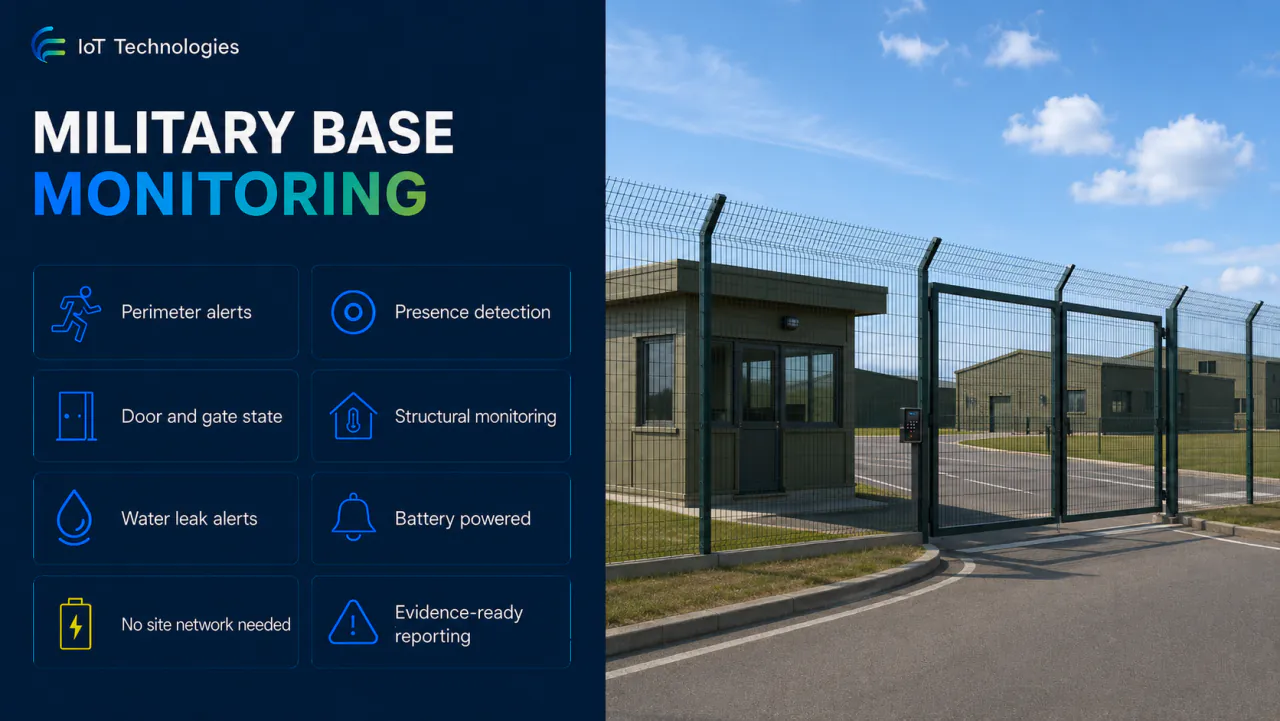
Secure facilities with controlled operational visibility

IoT monitoring for defence-adjacent and secure facilities, connecting restricted estates, compounds, depots, hangars, comms rooms, controlled zones and critical assets into clearer exception alerts, operational evidence and governed response workflows.

IoT Technologies supports secure estate teams with careful, enquiry-led telemetry design that improves visibility, triage and evidence records while respecting restricted access, controlled disclosure and site-specific security governance.

IoT Technologies defence and secure-facility estate monitoring — restricted-zone integrity, tamper detection, environmental conditions and asset condition shown as live readings.

Controlled estate visibility

Improve secure-estate awareness without exposing sensitive operational detail.

Controlled disclosure

Shape public-safe monitoring scopes around restricted estates, controlled zones and sensitive workflows without exposing operational detail.

Secure estate exception alerts

Surface abnormal movement, zone transitions, access-related events, environmental drift and device-health issues for review and response.

Evidence-ready reporting

Preserve timestamps, acknowledgements, response notes and event histories for audit preparation, incident review and supplier accountability.

Governed deployment

Design gateway placement, telemetry cadence, data handling and escalation paths around site-specific governance and access constraints.

Secure facilities need monitoring that is useful, conservative and governed. The purpose is to support operational visibility, triage and evidence records, not to disclose sensitive layouts, replace security procedures or claim certification, accreditation or official defence approval.

Defence-adjacent estates and secure facilities often combine restricted access, segmented networks, compounds, depots, hangars, communications rooms, perimeter assets, plant areas, stores and controlled zones. Visibility is important, but disclosure must be handled carefully.

The operational challenge is knowing what changed, when it changed and which events need review while respecting site security, access control, information boundaries and existing governance. Monitoring should reduce ambiguity without creating unnecessary exposure.

IoT Technologies designs secure-facility telemetry around public-safe scoping, careful disclosure and practical deployment constraints. Gateway-led, low-power sensing can support presence cues, movement events, zone transitions, environmental drift, tamper-style signals where appropriate, device health and evidence records.

A coverage-first approach helps where cabling, mains power, access windows or conventional connectivity are constrained. 433 MHz, 868 MHz and mixed gateway architectures can be assessed around compounds, outbuildings, communications spaces, plant areas, stores and hard-to-reach zones where a site-specific survey supports them.

Exception-led monitoring is more useful than noisy dashboards. Teams may need to see abnormal movement, access-related events, unexpected zone transitions, out-of-hours changes, asset presence, environmental drift or device-health issues so that response owners can triage quickly.

Evidence must be reliable and appropriately controlled. Event histories, timestamps, acknowledgements, response notes, device status and reporting outputs can support audit preparation, incident review, supplier accountability and governance conversations without claiming guaranteed outcomes.

Security and safety responsibilities remain with the site. IoT monitoring can support awareness and response workflow, but it does not replace guarding, access control, security procedures, safety-critical systems, statutory duties, accreditation processes, classification handling or formal risk management.

A responsible rollout starts with a public-safe brief and a small representative pilot. Define disclosure boundaries, priority events, asset classes, coverage assumptions, alert routes and evidence outputs, then validate signal quality and workflow fit before scaling.

The result is a practical secure-estate monitoring layer: clearer exceptions, better evidence records, more consistent response workflow and less reliance on incomplete manual observations.

01

Restricted estate visibility

See high-signal changes across controlled facilities and compounds.

Gateway-led telemetry can support useful presence, movement, zone-transition, environmental and device-health cues across secure estates where access and connectivity are constrained.

02

Compounds and controlled zones

Support awareness around spaces where manual checks leave gaps.

Compounds, depots, stores, hangars, communications rooms, plant areas and controlled zones can be assessed for practical sensing, gateway coverage and exception-led alerting.

03

Access and movement exceptions

Route abnormal events to the right response owners.

Unexpected movement, access-related cues, out-of-hours changes, abnormal zone transitions and tamper-style signals where appropriate can be shaped into reviewable events.

04

433 MHz and 868 MHz

Assess low-power coverage around hard-to-reach secure estates.

433 MHz, 868 MHz, gateway-led and mixed telemetry approaches can be surveyed around buildings, compounds, metalwork, plant spaces, stores and remote zones where deployment governance allows.

05

Environmental and plant cues

Track site-condition drift where resilience depends on early awareness.

Temperature, humidity, moisture-risk cues, enclosure conditions, plant-space drift and device-health events can support earlier triage for operationally important spaces.

06

Governance and evidence

Keep records useful without overclaiming security or accreditation outcomes.

Timelines, acknowledgements, response notes, event histories and reporting outputs can support governance, audit preparation and incident review while formal security duties remain site-specific.

Deployment approach

Start with public-safe scoping, disclosure boundaries and acceptance criteria.

Secure-facility monitoring should begin with careful definition of what can be discussed, what should be monitored, who owns response and how evidence will be handled.

We define the estate scope, controlled zones, asset classes, response workflow, disclosure boundaries, governance needs and reporting outputs, then assess mounting, power, gateway placement, RF coverage and data handling. Tags, sensors, thresholds, alert routes and reports are configured around a focused pilot before scaling.

Scope

Define public-safe estate scope, controlled zones, asset classes, priority events, governance owners, response routes and evidence needs.

Set boundaries

Survey

Assess compounds, stores, comms rooms, plant spaces, mounting positions, power options, gateway placement, RF coverage and access constraints.

Map constraints

Configure

Set sensors, tags, cadence, zone rules, exception thresholds, acknowledgements, alert routes, device-health checks and reporting outputs.

Tune signals

Prove

Run a representative pilot, validating signal quality, disclosure controls, response workflow, evidence records and operational usefulness.

Pilot proof

Scale

Extend the proven pattern across additional zones, assets, reporting groups and facilities with consistent governance and evidence handling.

Estate rollout

Bring a public-safe brief, site type, priority event categories, operational constraints, response workflow and evidence requirements. We will shape a pilot around careful disclosure, signal quality, workflow fit and reporting value.

Plan a secure-facility monitoring pilot

Applications

Where secure-facility telemetry improves visibility, response and evidence.

Compounds, depots and secure stores

Support controlled visibility for assets, stores, compounds, depots and operational spaces where access is restricted or intermittent.

Communications rooms and plant spaces

Monitor environmental drift, device-health cues, access-related events and operational conditions in sensitive technical spaces.

Controlled-zone movement

Surface unexpected movement, abnormal zone transitions and out-of-hours changes where review and response workflow matter.

Perimeter-adjacent assets

Support exception-led awareness around exposed assets, cabinets, gates, compounds and perimeter-adjacent infrastructure where appropriate.

Supplier and contractor workflows

Preserve event histories, response notes and acknowledgement paths that help internal teams and approved suppliers work from a shared record.

Audit preparation and incident review

Maintain controlled evidence records that support governance conversations, investigation support and incident review without overclaiming outcomes.

FAQ

Frequently asked questions

How does IoT monitoring work in secure facilities?

It adds exception alerts and evidence records across restricted estates, compounds, depots, hangars and comms rooms, designed enquiry-led and deployed under the site's own security governance and disclosure rules.

What can be monitored on a secure estate?

Access and movement exceptions in controlled zones, environmental and plant conditions in critical rooms, and site state across compounds — with alert routing shaped around governed response workflows.

How is sensitive site information handled?

Conservatively. Public materials and enquiry forms carry no sensitive operational detail; specific requirements are discussed under your controlled-disclosure arrangements and the deployment respects site-specific security governance.

Does it replace guarding, access control or security procedures?

No. It complements existing security measures by surfacing exceptions earlier and preserving evidence; guarding, access control, accreditation processes and formal risk management remain exactly as your governance requires.

Is the system accredited for defence use?

No accreditation or official approval is claimed. Engagements are enquiry-led, and each deployment is shaped to the facility's own assurance, governance and disclosure requirements.

Make secure estates
more visible, evidenced and accountable.

Share the public-safe scope, site constraints, asset classes, controlled zones, governance needs and evidence requirements. We will help shape a careful secure-facility monitoring pilot with appropriate disclosure boundaries and clear acceptance criteria.

Location

Aylsham Business Park, Norwich

Norfolk NR11 6FD · VAT GB 409644484

Secure-facility monitoring enquiry

Tell us about your restricted estate, compounds, controlled zones, assets, gateways, alert routing, governance model and evidence reporting needs at a level suitable for public enquiry.

No mailing lists. No spam. We reply directly to your enquiry.