
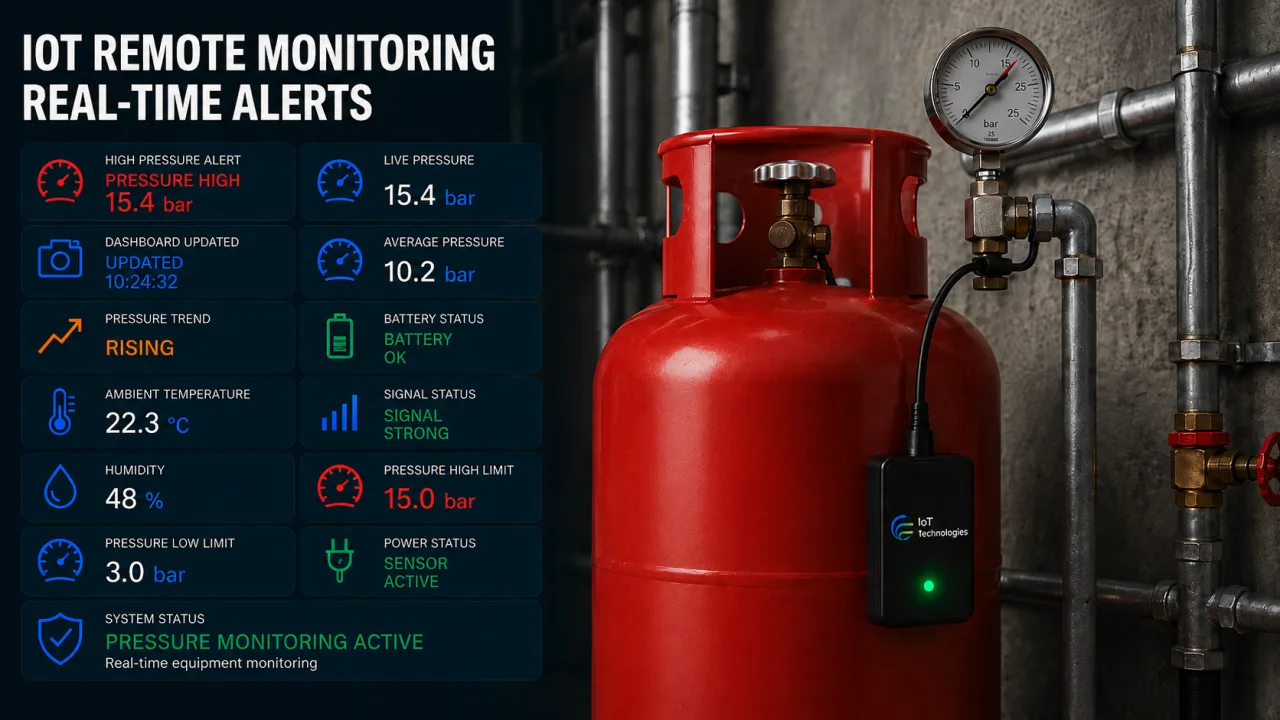
Field visibility
See what is happening between manual inspections.
Remote monitoring gives teams live visibility of spaces, assets and conditions that would otherwise sit unseen until a visit, fault report or escalation.
Secure remote monitoring for distributed estates, plant rooms, comms spaces, field assets and constrained-access locations, turning sensor signals into actionable alerts, escalation and evidence-ready histories.
IoT Technologies designs the sensing, connectivity, gateways and workflows that help operational teams see what has changed before a missed inspection becomes downtime, damage or emergency attendance.

Remote operational visibility
Designed for remote, constrained-access and poor-connectivity sites where routine manual checks leave long blind spots.
Thresholds, trends, severity and escalation routing turn raw telemetry into clear operational decisions.
Event timelines, acknowledgements, device health and response notes preserve the record teams need after an incident.
Gateways, dashboards, exports, APIs and alert workflows can be shaped around existing operational systems.
Remote monitoring is not another dashboard. It is an operational signal layer that tells teams what changed, where it happened, how serious it is and what response should follow.
Remote monitoring matters when it reduces uncertainty between inspections. Many teams already have alarms, logs, BMS data, spreadsheets and contractor notes, yet still discover problems late because the useful signal is scattered or missing. A practical monitoring layer gives teams earlier warning, cleaner ownership and a defensible record of what happened.
IoT Technologies builds remote monitoring around field reality: distributed estates, locked rooms, remote compounds, plant areas, cabinets, rooftops, basements, utility spaces and assets that are expensive or difficult to visit. Some sites have poor Wi-Fi. Some have limited power. Some need battery devices, gateway buffering, cellular backhaul, Ethernet or suitable RF paths depending on the environment.
The monitoring plan starts with the decision that needs to be made. That may be an environmental excursion, temperature drift, humidity risk, water ingress, pressure change, door access, tamper, power state, vibration, run status, equipment health or a custom digital input. The value is not the sensor itself; the value is knowing whether something has changed enough to require action.
Connectivity is engineered per site. Depending on distance, building fabric, power, payload and gateway position, deployments may use 433 MHz, 868 MHz, LoRaWAN-style profiles, cellular, Ethernet, Wi-Fi where appropriate, or mixed gateway architectures. The correct answer is proven through survey and pilot rather than assumed from a datasheet.
Alerting must be disciplined. A noisy monitoring system will be ignored. Thresholds, trend rules, escalation paths, acknowledgement records and response notes should be shaped around the team that will act on the event. Critical alerts need immediate routing. Slow drift needs early warning. Recurring issues need evidence so maintenance can prioritise the right fix.
Remote monitoring also needs to monitor itself. Battery level, signal strength, gateway health, last-seen time, missed payloads and device state are part of the operating record. Teams should know whether the site is healthy, whether the device is healthy and whether the data pathway is delivering as expected.
Evidence is central where assurance matters. Event timelines, alert delivery, acknowledgements, response notes and historical readings help teams understand what happened and demonstrate what response followed. That can support incident review, insurer conversations, governance, compliance-support workflows and contractor handover without overclaiming statutory compliance.
Integration keeps the system useful. Some teams need a dashboard. Others need email, SMS, API handoff, exports or a gateway-side workflow that fits existing operations. We design the monitoring pathway so data can be normalised, buffered, routed and reported without forcing every stakeholder into a new silo.
The strongest deployments start with a focused pilot. We pick representative sites, define the signals and acceptance criteria, prove coverage and alert quality, then scale the pattern across more assets, buildings, contractors and regions. That keeps the monitoring layer practical, measurable and aligned with operational value.
Field visibility
Remote monitoring gives teams live visibility of spaces, assets and conditions that would otherwise sit unseen until a visit, fault report or escalation.
Connectivity constraints
433 MHz, 868 MHz, LoRaWAN-style profiles, cellular, Ethernet, Wi-Fi or mixed gateways can be assessed against range, payload, power, building fabric and operating requirements.
Alert routing
Severity rules, routing, acknowledgement and handover records help the right team respond with context instead of chasing unclear alarms.
Device health
Battery level, signal strength, last-seen time, gateway state, missed payloads and retry behaviour make the data pathway visible, not assumed.
Evidence and assurance
Remote monitoring can record what changed, when alerts were sent, who acknowledged them and what response followed for review, governance and contractor handover.
Scalable operations
Once the pilot is proven, the same pattern can scale across additional sites while keeping alert rules, evidence outputs and reporting consistent.
Deployment approach
Useful remote monitoring begins with the operational decision, not with a catalogue of sensors.
We map the sites, assets, signals, response owners and evidence requirements, then survey coverage, power and access constraints. Devices, gateways, alert rules and reporting are configured around a pilot that proves signal quality, event routing and operational value before scaling.
Define sites, assets, conditions, response owners, evidence needs, alert channels and the decisions monitoring must support.
Define signals
Check access, mounting, power, gateway position, 433 MHz or 868 MHz coverage, cellular or Ethernet options and environmental constraints.
Confirm path
Set thresholds, trend rules, alert severity, routing, acknowledgement, device-health reporting and data handoff.
Tune alerts
Run representative sites through pilot acceptance, including signal quality, missed-payload behaviour, escalation and evidence review.
Pilot proof
Roll the proven monitoring pattern across additional sites, regions, assets and contractor workflows with consistent reporting.
Estate rollout
Bring the site list, access constraints, signal requirements, escalation workflow and reporting needs. We will shape a remote monitoring pilot around measurable operational control.
Plan a remote monitoring pilotApplications
Monitor assets, access, power state and environmental conditions where attendance is costly and connectivity is inconsistent.
Track temperature, humidity, water-risk signals, access events and equipment-support conditions before failures escalate.
Create a consistent exception layer across buildings, depots, campuses, compounds and hard-to-reach operational spaces.
Bring cabinet state, tamper, door access, power, equipment health and site condition signals into one response workflow.
Capture abnormal temperature, humidity, pressure, vibration, liquid level, water ingress or custom sensor events where appropriate.
Give internal teams and contractors clear event context, acknowledgement records and response evidence before attendance.
FAQ
It is sensing, connectivity and alerting for sites that are hard to reach or rarely visited, turning field signals into actionable alerts, escalation and evidence-ready histories instead of waiting for the next inspection.
Distributed estates, plant rooms, comms spaces, compounds and field assets where attendance is expensive, access is constrained or conditions change faster than the inspection cycle.
Low-power sub-GHz radio at 433 MHz and 868 MHz carries sensor data to gateways even from basements, cabinets and remote positions, so coverage does not depend on Wi-Fi or strong cellular signal.
Device health is monitored alongside the readings — regular check-ins, battery state and signal quality — so a silent sensor is itself an exception that gets flagged.
The event is routed as an alert to the right team with context and escalation rules, and it is recorded in the site history so the response can be reviewed and evidenced afterwards.
Yes. A proven single-site configuration rolls out across further sites with consistent dashboards and reporting, so the operational model stays the same as the estate grows.
Share the sites, assets, signals, access constraints and response workflow. We will help scope a practical remote monitoring pilot with clear acceptance criteria for signal quality, alert routing and evidence capture.
Direct contact
Location
Aylsham Business Park, Norwich
Norfolk NR11 6FD · VAT GB 409644484
Tell us about your sites, assets, signal types, connectivity constraints, alert requirements and operational response workflow.