Public sector estates with accountable operational visibility

IoT monitoring for local authority and public-sector estates, connecting civic buildings, schools, depots, libraries, leisure sites, housing offices and operational spaces into clearer alerts, evidence records and maintenance workflows.

IoT Technologies helps public-sector estate teams see risks earlier, prioritise limited resources and preserve clearer evidence across buildings and assets without forcing disruptive estate-wide replacement programmes.

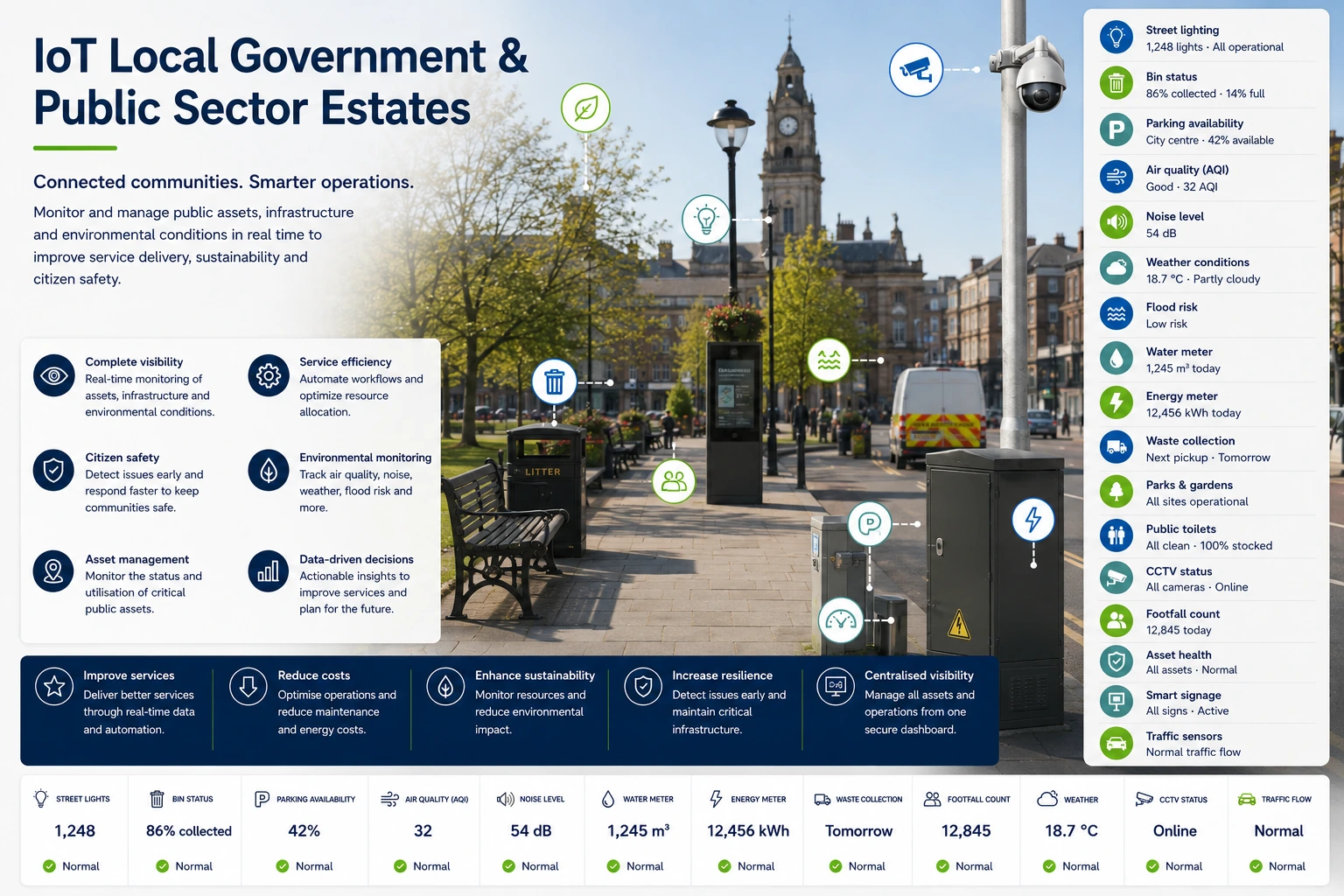
IoT Technologies local government and public-sector estate monitoring — leak detection, water metering, environmental conditions and estate visibility shown as live readings across civic buildings.

Public estate visibility

Give estate teams clearer signals across buildings, assets, contractors and service lines.

Multi-site oversight

Bring civic buildings, schools, libraries, leisure sites, housing offices, depots and operational spaces into a clearer monitoring model.

Budget-focused prioritisation

Use exception alerts and recurring-event evidence to focus limited maintenance resources where risk, disruption or repeated cost is highest.

Contractor workflow support

Preserve event timelines, acknowledgements and response notes that help internal teams and suppliers work from the same record.

Governance-ready evidence

Support audit preparation, incident review and insurer conversations with timestamped records, without overclaiming statutory or compliance outcomes.

Local authority and public-sector estates are broad, ageing and operationally mixed. Useful IoT monitoring has to improve visibility while respecting budget pressure, governance needs and existing service delivery models.

Councils and public-sector organisations manage many different building types: civic offices, schools, libraries, leisure centres, housing offices, community buildings, depots, operational compounds and public-facing service sites. Each has its own access rules, contractors, maintenance priorities and evidence requirements.

The problem is rarely a lack of effort. It is a lack of timely, consistent signals between inspections, service visits and contractor reports. Leaks, abnormal access, temperature drift, plant-room issues, environmental conditions and repeated faults can start small before they become expensive or disruptive.

IoT Technologies designs monitoring around the realities of public estates. Gateways, low-power sensors, RF tags and secure reporting can be deployed around older buildings, basements, risers, rooftops, service cupboards, depots and remote operational locations where standard connectivity and cabling are not always practical.

A public-sector monitoring layer can support leak detection, environmental monitoring, water-risk temperature evidence, plant-space visibility, access-event awareness, asset presence, utility visibility, exception alerts and contractor workflow. The goal is operational assurance and better evidence, not a claim to replace statutory duties or formal compliance processes.

Data is most useful when it supports decisions. Dashboards, alerts, acknowledgements, event histories and scheduled reports can help estate teams prioritise limited resources, identify recurring issues, challenge supplier assumptions and plan maintenance before reactive callouts consume more budget.

Contractor accountability matters. Clear timestamps, event timelines, device status, response notes and repeat-event patterns can help internal teams and suppliers work from the same evidence base. That supports governance conversations, incident review and audit preparation while keeping formal sign-off where it belongs.

A sensible rollout starts with representative sites rather than a broad, fragile deployment. We help define priority risks, survey coverage, configure thresholds and prove the workflow across a small number of buildings or service lines before scaling the pattern across the wider portfolio.

The result is a practical estate telemetry layer: better visibility of hidden spaces, earlier warning of service-impacting drift, clearer evidence for governance and more consistent reporting across sites, contractors and operational teams.

01

Estate portfolio

See more of the public estate between inspections and service visits.

Sensors, tags and gateways can support visibility across civic buildings, schools, libraries, leisure centres, housing offices, depots, compounds and operational spaces where manual checking leaves gaps.

02

Water and environment

Surface leak, temperature, humidity and plant-space risks earlier.

Leak detection, temperature evidence, humidity trends, plant-room cues, cold-space conditions and environmental signals can be routed to the right teams before issues become repeated reactive work.

03

Contractor workflow

Give suppliers and internal teams a clearer shared evidence trail.

Event histories, timestamps, acknowledgement paths and response notes can support contractor handover, service review, repeated-fault analysis and governance conversations.

04

433 MHz and 868 MHz

Design coverage around older buildings and hard-to-reach spaces.

Coverage can be assessed around basements, risers, rooftops, service cupboards, plant rooms, depots and remote sites using 433 MHz, 868 MHz, gateway-led and mixed telemetry approaches where appropriate.

05

Operational assurance

Turn hidden estate events into usable alerts and reports.

Access anomalies, abnormal movement, device-health events, environmental drift, utility cues and recurring exceptions can be shaped into dashboards, alerts and reporting outputs that support operational assurance.

06

Public-sector governance

Support audit preparation without overclaiming compliance outcomes.

Evidence-ready logs, exports, acknowledgements and trend reports can help with audit preparation, incident review and supplier accountability while statutory duties and formal compliance processes remain deployment-specific.

Deployment approach

Start with representative sites, priority risks and evidence needs.

Public-sector monitoring works best when the first deployment proves coverage, workflow fit and reporting value before it expands across the wider estate.

We define the estate types, priority service lines, risk areas, contractor model and governance outputs, then survey buildings and operational spaces for mounting, gateway placement, power, RF coverage and data integration. Sensors, tags, thresholds, alerts and evidence reports are configured around a focused pilot before scaling.

Scope

Define estate types, public buildings, service lines, priority risks, contractors, governance needs, reporting groups and measurable pilot outcomes.

Set priorities

Survey

Check basements, risers, plant rooms, rooftops, depots, cupboards, mounting positions, power options, gateway placement and RF coverage constraints.

Map coverage

Configure

Set sensors, tags, thresholds, cadence, escalation routes, acknowledgements, device-health checks, reports and evidence outputs around the workflow.

Tune workflow

Prove

Pilot representative buildings or service lines, validating signal quality, alert usefulness, contractor handover, reporting value and evidence records.

Pilot proof

Scale

Extend the proven pattern across additional buildings, zones, contractors and reporting groups with consistent standards and governance.

Portfolio rollout

Bring the estate list, priority buildings, contractor responsibilities, known recurring issues, reporting needs and acceptance criteria. We will shape a practical pilot around coverage proof, alert usefulness, response workflow and evidence value.

Plan a public-sector estate pilot

Applications

Where public-sector telemetry improves visibility, response and evidence.

Civic buildings and public offices

Monitor plant rooms, service cupboards, access events, utility cues and environmental conditions across public-facing and back-office sites.

Schools, libraries and community buildings

Support earlier warning for leaks, temperature drift, environmental issues and hidden service-space risks across distributed community assets.

Depots and operational sites

Track depot spaces, compounds, stores, tools, equipment presence, access anomalies and environmental conditions where services depend on uptime.

Housing and managed property estates

Add telemetry where landlord, maintenance, water-risk, plant-space or recurring issue visibility can support better prioritisation and evidence.

Plant rooms, risers and basements

Use low-power sensing and gateway coverage for hard-to-reach spaces where manual inspection is infrequent or connectivity is difficult.

Contractor and governance workflows

Create shared event records, acknowledgements, response notes and reporting outputs for supplier review, audit preparation and incident analysis.

FAQ

Frequently asked questions

What can IoT monitoring do across a public-sector estate?

It connects civic buildings, schools, depots, libraries, leisure sites and housing offices into clearer alerts, evidence records and maintenance workflows, so a stretched estates team sees risk earlier across the whole portfolio.

How does it help with limited budgets?

Earlier warning converts reactive emergencies into planned work, and retrofit low-power sensing avoids estate-wide replacement programmes — resources go where the evidence says they are needed.

Does it support compliance and governance work?

It produces time-stamped records and exception histories that support assurance, audit preparation and governance review; it does not claim guaranteed statutory compliance, which remains with the responsible officers.

Can it support water-safety monitoring?

Yes. Temperature monitoring and flushing evidence at outlets support legionella control regimes across schools, leisure centres and civic buildings without relying only on manual logging.

How does it improve contractor accountability?

Attendance, response and completion are evidenced with timestamps, giving estates teams a factual record for contractor management and recharge or dispute conversations.

Make public estates
more visible, evidenced and accountable.

Share the estate type, priority buildings, existing contractor model, operational risks and reporting requirements. We will help scope a practical public-sector monitoring pilot with clear acceptance criteria for coverage, alerts, evidence records and workflow fit.

Location

Aylsham Business Park, Norwich

Norfolk NR11 6FD · VAT GB 409644484

Public-sector estate monitoring enquiry

Tell us about your buildings, depots, schools, libraries, leisure sites, housing offices, plant rooms, contractors, governance needs and reporting workflow.

No mailing lists. No spam. We reply directly to your enquiry.