01
Asset location cues
Make critical equipment easier to find and account for.
Shared clinical and support equipment can be tagged so teams have better visibility of presence, zone movement and location cues across the healthcare estate.

IoT asset monitoring and estate monitoring for hospitals, clinical buildings, wards, theatres, stores, plant rooms and service corridors where critical equipment, restricted zones and environmental signals need evidence-ready visibility.
IoT Technologies helps healthcare estates and clinical support teams locate critical mobile equipment, surface movement exceptions, monitor sensitive spaces and preserve operational evidence without disrupting patient care or existing workflows.
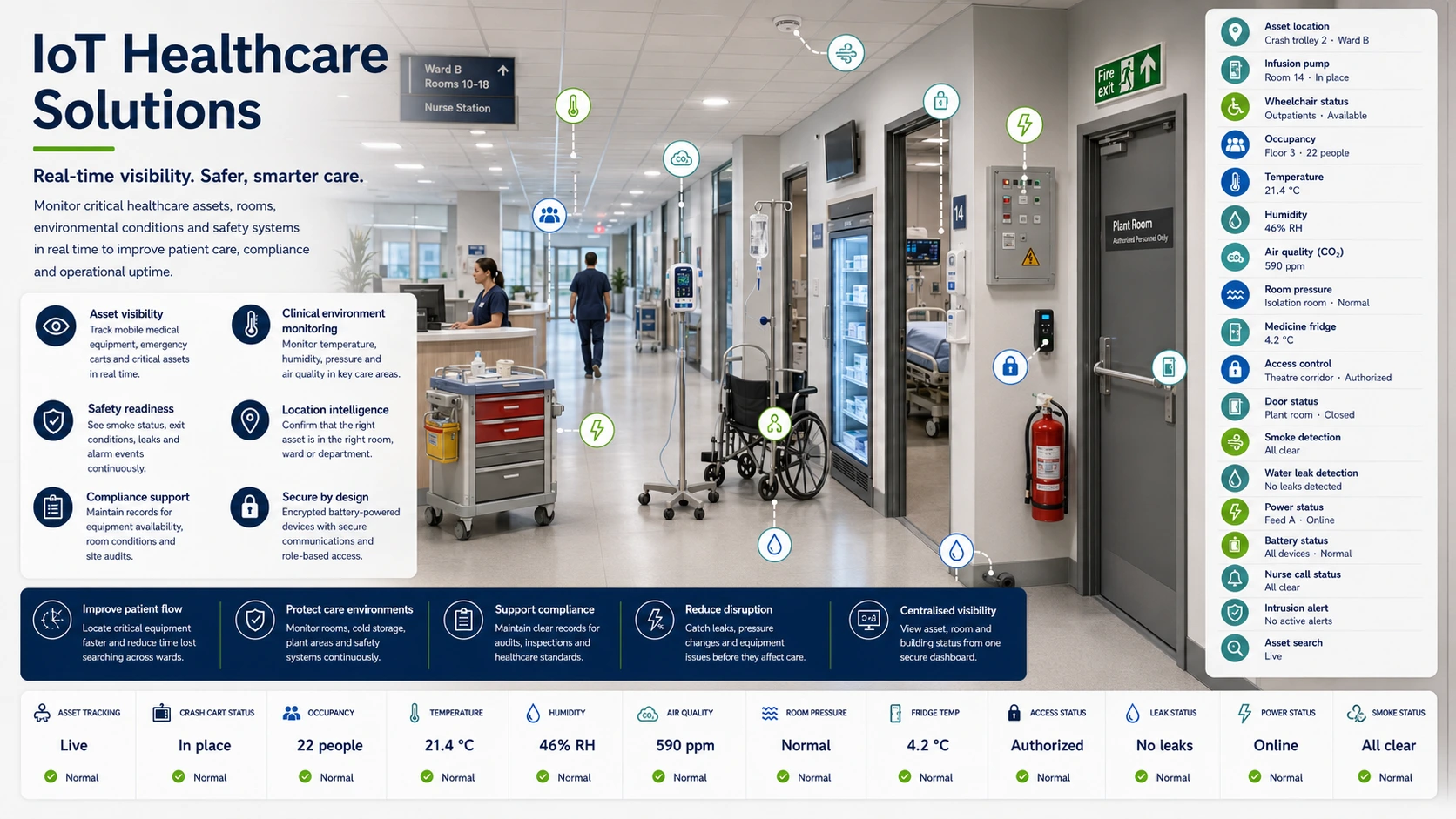
Clinical estate visibility
Track useful location and movement cues for shared equipment across wards, theatres, stores, treatment areas and service routes.
Design gateways, tags, sensors and cadence around clinical workflows, building constraints and operational governance.
Monitor temperature, humidity, storage conditions, water-risk cues, plant-room drift and device health where useful.
Preserve timelines, acknowledgements, zone events and response notes for audit preparation, incident review and supplier accountability.
Healthcare monitoring must be useful, low-disruption and careful. The goal is to improve operational visibility and evidence, not to interrupt care or overclaim compliance outcomes.
Healthcare estates are busy, complex and constantly changing. Infusion pumps, monitors, beds, wheelchairs, diagnostic carts, defibrillators and other high-value devices move between wards, theatres, stores, treatment rooms and service areas. When equipment cannot be found quickly, teams lose time and shared assets are harder to manage.
IoT Technologies designs healthcare asset and estate monitoring around real hospital constraints: infection control practices, staff workload, restricted areas, shielded corridors, basements, plant rooms, service routes, mixed building fabric and inconsistent connectivity. The monitoring layer must be practical for the estate, not an extra burden for clinical teams.
A coverage-first approach matters. Gateways can establish local coverage while low-power tags and sensors provide predictable observations with practical cadence. Depending on the site, deployments may use 433 MHz, active RFID-style approaches, LoRaWAN-style profiles or mixed architectures where survey and governance support them.
Asset visibility is most valuable when it reduces search time and improves accountability. Teams may need to see whether equipment is present in the correct zone, whether it has moved unexpectedly, whether a restricted-area transition has occurred, or whether assets are accumulating where they should not be.
Healthcare estates also depend on environmental and plant reliability. Temperature, humidity, storage-condition cues, water-risk signals, plant-room drift, device health and gateway status can help estates teams identify problems before they become operational disruption.
Evidence must be handled carefully. Event histories, timestamps, zone transitions, environmental readings, acknowledgements and response notes can support incident review, supplier accountability, audit preparation and governance conversations. They support assurance; they do not replace statutory requirements, clinical judgement or formal compliance processes.
The system should fit existing workflows. Dashboards, alerts, reports, API handoff and exports can be shaped around estates, clinical engineering, stores, governance, contractors and operational teams so data becomes useful rather than stranded in another tool.
A safe rollout starts with a focused pilot. Select defined equipment classes and high-risk zones, validate coverage in wards, theatres, basements and plant rooms, agree acceptable cadence and evidence outputs, then scale once the system has proven value and low disruption.
The result is better operational visibility: equipment is easier to locate, movement exceptions are clearer, sensitive estate conditions are monitored, and teams have stronger evidence when reviewing incidents or planning improvements.
Asset location cues
Shared clinical and support equipment can be tagged so teams have better visibility of presence, zone movement and location cues across the healthcare estate.
Ward and theatre workflows
Movement and zone-transition events can help reduce search time, improve turnaround and make shared equipment flows easier to understand.
Restricted-zone movement
Restricted-area transitions, abnormal zone changes, stores movement and controlled-area events can support governance and operational review.
433 MHz radio
433 MHz, active RFID-style approaches, LoRaWAN-style profiles and mixed gateway architectures can be assessed around basements, plant rooms, service corridors and shielded spaces.
Environmental and plant cues
Temperature, humidity, storage-condition signals, water-risk cues, plant-room drift and device-health events can be routed to estates teams where appropriate.
Evidence and governance
Timelines, event histories, acknowledgements and response records support audit preparation, incident review and supplier accountability while formal compliance remains process-specific.
Deployment approach
Healthcare monitoring should be piloted carefully around patient-care constraints, estates workflows and evidence requirements.
We define equipment groups, zones, movement rules, environmental signals and response owners, then survey coverage, mounting and gateway placement. Tags, sensors, alerts and reports are configured around a representative pilot before scaling.
Define equipment classes, wards, theatres, stores, restricted zones, environmental risks, response owners and evidence outputs.
Define estate
Check basements, plant rooms, service corridors, ward layouts, 433 MHz coverage, gateway placement and access constraints.
Map coverage
Set tags, sensors, cadence, zone rules, movement exceptions, alert routes, device-health checks and reporting outputs.
Tune events
Run a representative pilot, validating coverage, search-time improvement, alert usefulness, evidence quality and operational disruption.
Pilot proof
Extend the proven pattern across equipment classes, buildings, departments and estates teams with consistent governance.
Estate rollout
Bring the equipment list, priority zones, building constraints, governance requirements and operational workflow. We will shape a pilot around measurable search-time, visibility and evidence value.
Plan a healthcare monitoring pilotApplications
Improve visibility of pumps, monitors, beds, wheelchairs, carts and high-value devices as they move between clinical and support areas.
Support zone visibility, shared-equipment flow, turnaround and accountability across busy operational areas.
Add telemetry in shielded or hard-to-reach estate spaces where standard connectivity and manual checks are unreliable.
Surface unexpected movement, zone transitions and controlled-area events where governance or asset accountability matters.
Track temperature, humidity, water-risk or storage-condition signals where estate teams need earlier warning.
Maintain event histories, acknowledgements and response records that support governance conversations and supplier accountability.
FAQ
It helps teams locate critical mobile equipment, surface movement exceptions in restricted zones, monitor sensitive spaces and preserve operational evidence — all without disrupting patient care or existing clinical workflows.
Yes. Presence and movement cues show where pumps, beds and portable devices were last seen and when they moved, cutting the search time that erodes clinical hours.
No. The sensing is low-power, unobtrusive and installed around clinical workflows, with alert routing designed so the right support team responds without adding noise to wards and theatres.
Movement exceptions in stores and controlled zones, environmental conditions in wards, theatres and plant rooms, and the state of spaces where evidence and timely response matter.
It produces time-stamped records and exception histories that support governance, assurance and audit preparation; statutory and clinical responsibilities remain with the accountable teams.
Share the estate, equipment classes, priority zones, coverage constraints and governance workflow. We will help scope a practical healthcare monitoring pilot with clear acceptance criteria for location visibility, movement exceptions, environmental signals and evidence records.
Direct contact
Location
Venator House, Unit 9, 15-17 St Stephen's Road, Bournemouth
Dorset, BH2 6LA · VAT GB 409644484
Tell us about your hospital estate, equipment types, wards, theatres, stores, restricted areas, environmental risks and reporting needs.