
Services

Turn IoT telemetry into early warning

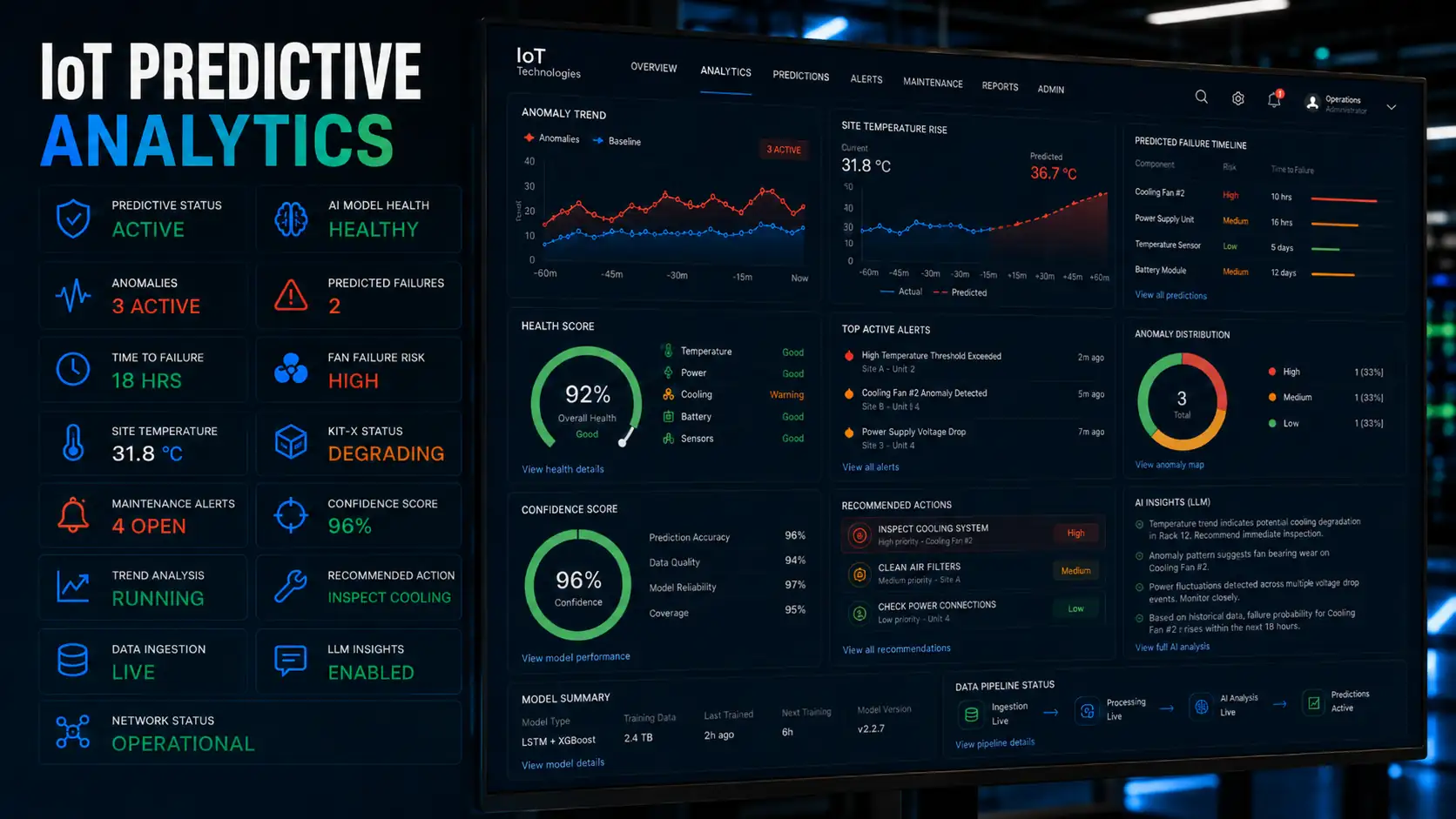
Predictive analytics turns the stream of telemetry coming off your devices into something you can act on: trends, anomalies and early warnings, rather than raw numbers nobody has time to read. The platform watches the data continuously, flags when a reading drifts away from its normal pattern, and surfaces it early — while there is still time to do something about it. It is decision support, not a crystal ball: the analytics point you at what is worth looking at and why, and your team decides what to do. Built and run in the UK by the same engineers who design the devices, it is grounded in how the equipment actually behaves in the field — not a generic model bolted on top.

IoT Technologies predictive analytics — trends, anomaly detection and early warnings from telemetry
Early
Warnings while there's still time to act
Anomalies
Drifts from normal flagged automatically
Grounded
In how your equipment behaves in the field
UK
Built and run by the team behind the devices
01

From raw telemetry to something you can act on

A device in the field produces a constant stream of readings. On its own that is just data — most of it never looked at. Predictive analytics turns it into something useful: the trends that matter, the readings drifting out of normal range, and the early signals that something is changing before it becomes a problem. The point is not to drown you in dashboards but to put the few things worth your attention in front of you, with enough context to act.

02

Anomaly detection that flags the unusual

The platform learns what normal looks like for each device and each site, then watches for departures from it — a reading climbing when it should be steady, a pattern that no longer fits, a value outside the band it has held for months. When something drifts, it is flagged and ranked, so a genuine early signal is not lost in routine noise. Because normal is learned per device and per site rather than set to a single global threshold, the flags are relevant to that specific deployment rather than generic.

03

Early warning, not a crystal ball

We are deliberately honest about what predictive analytics is. It is early warning and decision support, not a guarantee about the future. The analytics tell you where to look and why — which asset is trending the wrong way, how strong the signal is, and what changed — and your team makes the call. Used this way it is genuinely valuable: it buys time, focuses attention and turns reactive firefighting into planned action. Sold as certainty it would be dishonest, and we will not pretend a model can promise exactly when something will fail.

04

Grounded in how your equipment behaves

Analytics are only as good as their grasp of the thing being measured. Because the same UK team designs the devices, writes the firmware and builds the platform, the analytics are grounded in how the equipment actually behaves in the field — the conditions, the failure modes, the quirks of real deployments — rather than a generic model applied from the outside. That domain knowledge is the difference between a flag that means something and an alert nobody trusts.

05

Where it earns its keep

The value shows up in the everyday: a slow leak whose flow signature is drifting upward, caught before it becomes damage; movement or sway on a structure trending beyond its normal range; the temperature and condition of a consignment moving outside acceptable bounds in transit; equipment whose readings are creeping toward the edge of normal. In each case the analytics give you the warning early enough to act on your terms, rather than after the fact.

06

Built, run and supported in the UK

The analytics are built and run in the UK by the same engineers behind the devices and the platform — one team accountable for the whole chain, from the sensor to the warning. When a flag needs explaining, the people who can explain it are the people who built it. As deployments grow, the same analytics scale with them, from a single site to an estate, without changing the principle: surface the few things that matter, early, to the people who can act.

FAQ

Frequently asked questions

What does IoT predictive analytics actually do?

It turns the telemetry from your devices into trends, anomaly flags and early warnings — surfacing the readings drifting out of normal so you can act before they become problems.

Can it tell me exactly when something will fail?

No, and we won't claim it can. It is early warning and decision support: it points you at what is trending the wrong way and how strong the signal is, and your team decides what to do.

How does it know what is abnormal?

It learns what normal looks like for each device and each site, then flags departures from that pattern — so the warnings are relevant to that specific deployment rather than a single global threshold.

Where does predictive analytics add the most value?

Anywhere an early signal buys time: a leak whose flow is drifting up, a structure moving beyond its normal range, or a consignment whose condition is heading out of bounds in transit.

Is it built specifically for our equipment?

Yes. Because the same UK team designs the devices and builds the platform, the analytics are grounded in how your equipment behaves in the field, not a generic model applied from outside.

Make your site signals visible, usable and evidenced.

Tell us about the sites, assets and conditions you need to monitor. We will help scope a practical pilot for reliable telemetry, real-time alerts and evidence-ready reporting.

Location

Aylsham Business Park, Norwich

Norfolk NR11 6FD · VAT GB 409644484

Tell us about your enquiry

Provide a few details about your sites, assets and operational needs. We will be in touch to discuss the right approach.

No mailing lists. No spam. We reply directly to your enquiry.