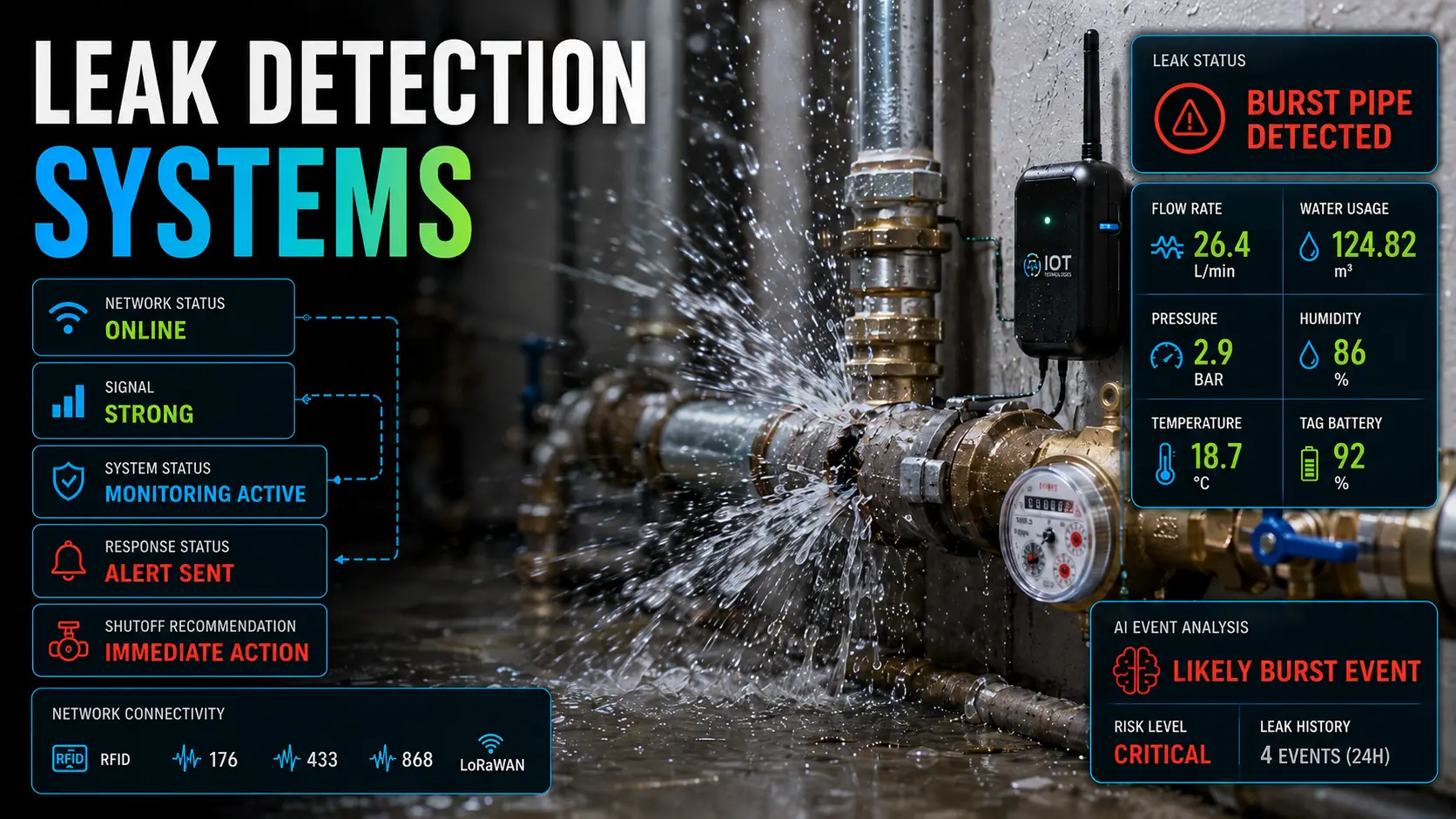
Specialist RF water-leak detection that runs from a single high-risk plant room to a national portfolio on the same architecture.
The system is built for retrofit. Battery-powered sensors go into the places water actually fails — plant rooms, risers, tank rooms, voids, under-sink runs, pump rooms and basements — without opening walls, pulling in cable or bending a building to fit a generic template. That suits facilities teams, hotels, student accommodation, commercial blocks, healthcare estates and public-sector buildings.
Detection is carried over low-power sub-GHz radio rather than wired loops or Wi-Fi. Sub-GHz penetrates the concrete, plant and below-ground positions where leaks hide and where 2.4 GHz and Wi-Fi do not reach, and the frequency and reporting profile are matched to each site rather than assumed. Sensors in wet and chamber locations are sealed to the appropriate IP rating, because a leak sensor that fails when it gets wet is worse than none.
We detect more than a puddle on a floor. Point sensors confirm water where it should never be; flow baselining catches slow losses and continuous draw; pressure-transient analysis flags burst-like signatures; and night-flow analysis surfaces water moving when the building should be still. Backflow, reverse flow and abnormal-usage conditions are treated as first-class events, not footnotes.
Catching the event is only half the job; the alert has to arrive. Routing is shaped around the operating model — event type, zone, time of day, occupancy and out-of-hours cover — and pushed to dashboard, SMS, email or nominated teams, with escalation if it is not acknowledged. Retry and redundancy in the radio layer keep that path intact from the awkward positions sensors actually sit in.
Battery life is engineered against sensor type, reporting cadence and site conditions, with selected devices designed for multi-year service so maintenance overhead does not kill a project before it scales. The same system runs a single pilot or an estate-wide rollout without losing the audit trail.
Analysis can be AI-assisted, running on local edge hardware or in the cloud to suit latency, data-residency and governance, and tuned to the RF profile a site uses — abnormal flow, burst signatures and night-flow patterns assessed automatically and raised as events rather than left in raw telemetry. Data can sit in a private PostgreSQL deployment or in AWS. This is a detection, alerting and evidence layer that strengthens a building's water-safety response; it does not replace plumbing design, statutory water-safety duties or a physical shut-off regime.