01
Remote site blind spots
Make lightly staffed telecoms infrastructure observable.
Towers, compounds, rooftops, remote huts and cabinets can be monitored for access, movement, tamper, environmental drift and asset-state changes.

IoT monitoring for telecoms towers, rooftops, compounds, remote huts, cabinets and critical site zones where perimeter events, access anomalies, equipment movement and environmental drift need reliable evidence.
IoT Technologies helps telecoms operators and infrastructure partners turn remote and lightly staffed sites into observable assets, using low-power sensing, gateway coverage and evidence-ready alert workflows.
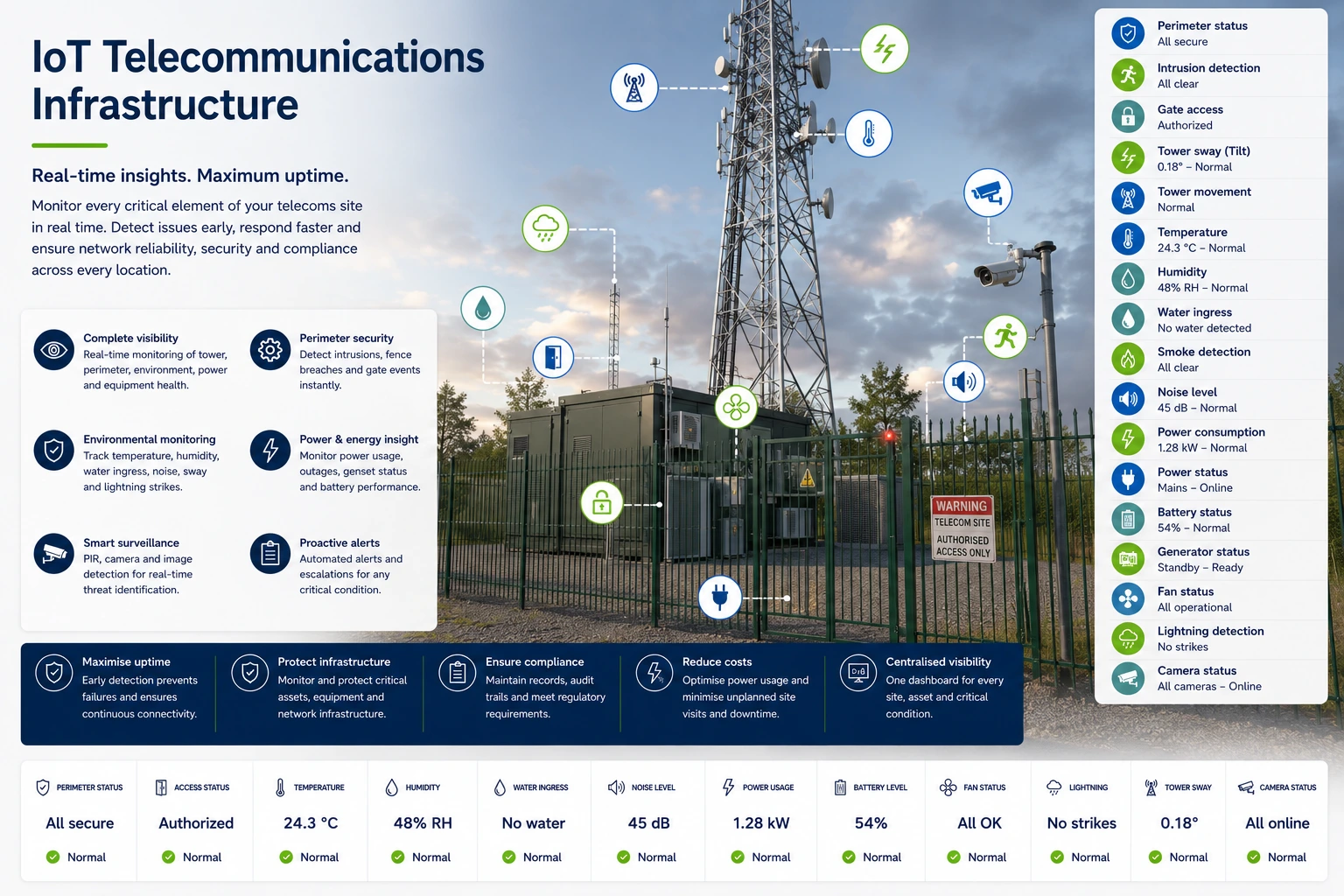
Remote telecoms estate visibility
Monitor remote telecoms sites, rooftops, huts, gates, cabinets and controlled zones where manual attendance is costly or delayed.
Surface gate, door, cabinet, tamper, access, dwell-time and movement events that help teams understand what changed.
Survey 433 MHz coverage and ZARC Node placement around site geometry, metalwork and cellular backhaul.
Preserve timestamps, provenance, device health, gateway delivery and response history for investigation and supplier accountability.
Telecoms infrastructure monitoring is valuable when it shortens triage, improves asset confidence and preserves evidence for sites that are hard to reach and accessed by multiple parties.
Telecoms towers, rooftops, compounds and remote huts are often lightly staffed, geographically distributed and accessed by contractors, field teams, landlords and specialist suppliers. When something changes on site, the operator may not have a clear record until the outage, audit gap or investigation begins.
The operational problem is wider than theft or vandalism. Operators need to know who was on site, what changed, whether equipment moved, whether a gate or cabinet changed state, whether power or environmental conditions drifted, and what evidence existed before and after an incident.
IoT Technologies designs telecoms infrastructure monitoring around field conditions: remote locations, metal-dense environments, cabinets, compounds, limited power, uncertain backhaul, harsh weather, constrained installation time and a need for repeatable deployment across many sites.
A coverage-first sensing layer can support real-time asset presence, cabinet and gate state, tamper, movement, abnormal dwell time, environmental drift, power-state cues and site-health signals. The goal is not a noisy feed. The goal is exception data that helps teams prioritise investigation and response.
A mains failure at an unmanned site often goes unnoticed until the backup batteries run down. Power monitoring here starts with the gateway: the ZARC Node reports mains loss and restoration by default, and its internal battery keeps it reporting while the site runs on backup. Where a single circuit or piece of equipment matters, a power failure tag reports that supply on its own.
Connectivity is engineered around the site. Tags report over 433 MHz, chosen for range and for getting through metal cabinets, cabin walls and building fabric, to a ZARC Node on site that backhauls over cellular. Range, compound layout, payload and node placement are surveyed before anything is fitted.
Low-power operation matters. Many useful sensing points are away from mains power or difficult to visit. Reporting cadence, battery visibility, signal quality, retry behaviour and gateway health are all part of the operating record, because a telecoms estate needs predictable support at scale.
Evidence-grade timelines reduce investigation friction. A record of gate access, cabinet state, asset movement, environmental drift, device health, gateway delivery and response notes gives teams a defensible narrative for incidents, supplier accountability, insurer conversations and repeated-site hardening.
Integration keeps the monitoring layer operational. Alerts, dashboards, API handoff, exports and contractor workflows should support the existing NOC, field operations and asset-management process rather than creating another isolated system.
The strongest deployments begin with a representative pilot across site types. We prove coverage and cadence in compounds, cabinets and hard RF positions, confirm event quality, then scale the pattern with standard thresholds, reporting and acceptance criteria.
Remote site blind spots
Towers, compounds, rooftops, remote huts and cabinets can be monitored for access, movement, tamper, environmental drift and asset-state changes.
Perimeter and access
Gate, door, cabinet, hatch, compound, restricted-zone and dwell-time events can support security, field operations and contractor handover workflows.
Asset confidence
Asset presence, unexpected movement, tamper, cabinet activity and site-state events can help reduce manual reconciliation and investigation time.
433 MHz radio
433 MHz coverage is surveyed around metalwork, cabinet positions and ZARC Node placement, with cellular backhaul from the node.
Mains power
The ZARC Node alerts on mains loss and on restoration as standard and keeps reporting on its internal battery through the outage. Power failure tags carry the same alerts to individual supplies and distribution boards, on any phase, so a power fault can be told apart from a network fault before anyone is sent to site.
Supplier accountability
Event histories, acknowledgement records, device state, gateway delivery and response notes help teams resolve disputes and improve site hardening.
Deployment approach
A telecoms monitoring rollout should prove coverage, cadence and evidence value across the site types that define the estate.
We map site categories, priority risks, assets, access points, power constraints and operational owners, then survey RF and gateway geometry. Devices, alerts and reporting are configured around a pilot before scaling across regions and contractors.
Define towers, rooftops, compounds, huts, cabinets, assets, access points, risk events, response owners and evidence needs.
Define sites
Check mounting, power, 433 MHz coverage, gateway placement, backhaul, metalwork, weather exposure and access constraints.
Map coverage
Set sensors, cadence, alert severity, dwell-time rules, device-health checks, evidence outputs and escalation routes.
Tune events
Run representative sites through pilot acceptance, validating event quality, signal path, response workflow and evidence usefulness.
Site proof
Roll the proven pattern across additional sites, contractors and regions with consistent thresholds and commissioning.
Estate rollout
Bring the site mix, priority assets, known blind spots, access process, escalation workflow and reporting needs. We will shape a telecoms monitoring pilot around measurable triage and evidence value.
Plan a telecoms monitoring pilotApplications
Monitor access, gate state, cabinet state, environmental conditions and asset movement across remote or hard-to-attend locations.
Surface door state, tamper, equipment movement, power-state cues, temperature drift and other exception signals where appropriate.
Add event records for gates, restricted areas, cabinets and access points where evidence supports security and operations.
Give field teams and third parties event context, timestamps and site-state records before and after attendance.
Track thermal, moisture, humidity, power or gateway-health signals that can precede equipment fault or service impact.
Standardise exception records, repeated-site trends, response notes and evidence outputs across regions and suppliers.
FAQ
Towers, rooftops, compounds, remote huts, cabinets and critical site zones — surfacing perimeter events, access anomalies, equipment movement and environmental drift as reliable alerts with evidence behind them.
Battery-powered, low-power sensing reports through gateway coverage engineered for the site, so lightly staffed and unmanned locations become observable without new power or connectivity build-out.
Teams attend on evidence instead of on rota: alerts say which site changed and why, so visits are prioritised where something actually needs attention.
Mains and battery state, thermal drift in cabinets and huts, and environmental conditions that precede equipment failure — alerted while there is still time to intervene.
As standard, the ZARC Node alerts on mains loss and on restoration by SMS or email to the people the operator chooses, with escalation if an alert is not acknowledged. It keeps reporting on battery through the outage, and power failure tags can monitor individual supplies on any phase.
Access events and site conditions are timestamped, giving operators an evidence trail for contractor attendance, work windows and disputes about what happened on site.
Share the site types, priority assets, access risks, compound layout, coverage constraints and operational workflow. We will help scope a telecoms monitoring pilot with clear acceptance criteria for coverage, cadence, evidence and response.
Direct contact
Location
Venator House, Unit 9, 15-17 St Stephen's Road, Bournemouth
Dorset, BH2 6LA · VAT GB 409644484
Tell us about your towers, compounds, rooftops, remote huts, cabinets, access risks, power constraints, telemetry and reporting workflow.