01
Distributed estates
Bring hard-to-reach utility assets into view.
Monitor meters, cabinets, kiosks, plant rooms, compounds and remote assets where access, coverage and power constraints make manual inspection expensive or inconsistent.

IoT monitoring for water, gas and power estates where meters, cabinets, compounds, plant spaces and remote infrastructure need dependable telemetry, exception alerts and evidence-ready operational records.
IoT Technologies, a UK designer and manufacturer of wireless monitoring, helps utility-adjacent teams, estates, operators and integration partners across the UK collect useful data from distributed infrastructure where manual checks, standard connectivity and generic monitoring platforms leave gaps.
Utility estate visibility
Support water and gas read collection, consumption records, non-read visibility and exception reporting where interfaces and deployment constraints allow.
Monitor cabinets, compounds, plant spaces, kiosks, utility rooms and distributed assets that are costly or difficult to inspect manually.
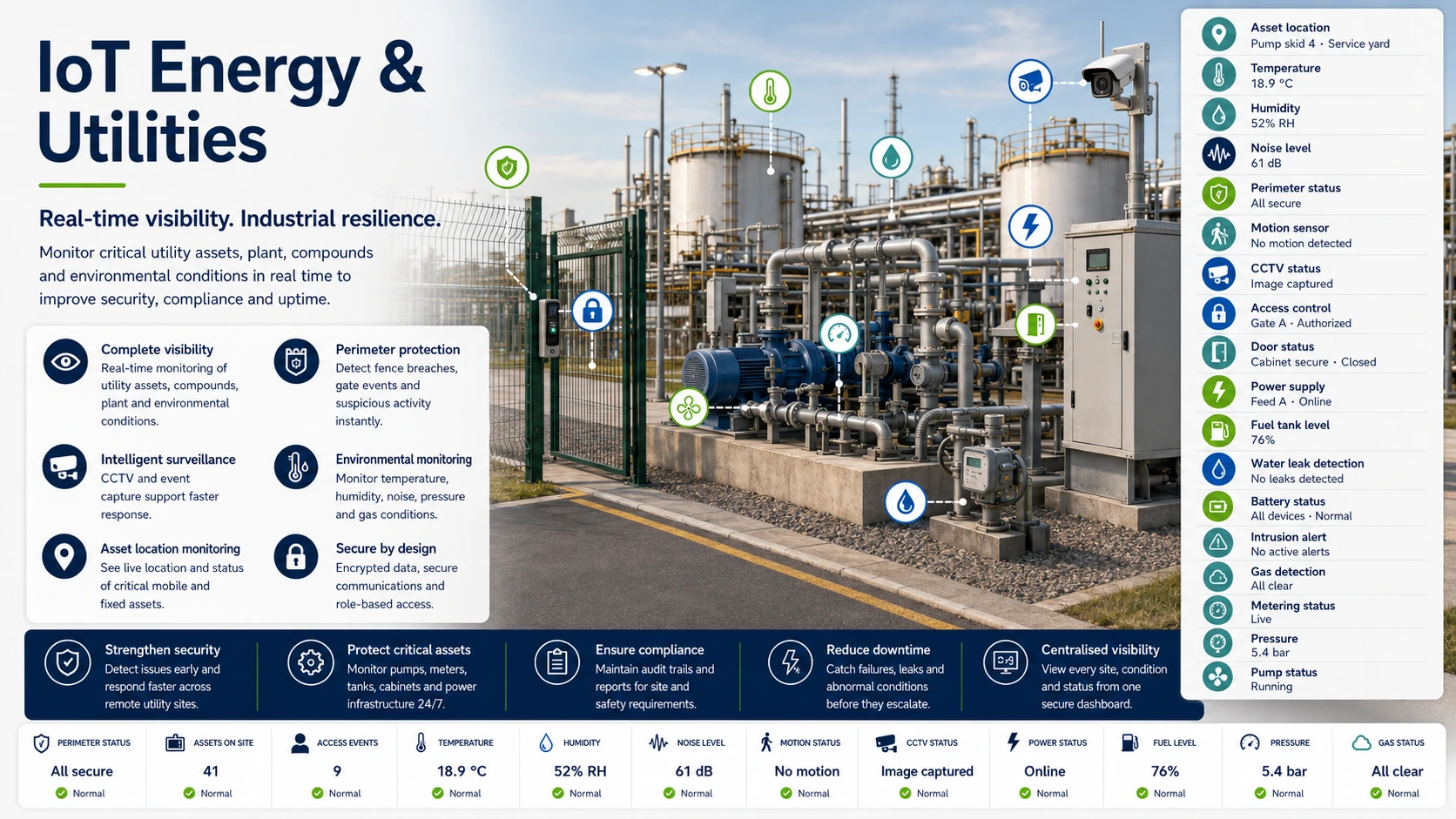
Monitor pressure, water leaks and flooding, power and supply state, and pump or plant-room faults across utility sites, with exception alerts routed to the right team.
Create records of reads, events, alerts, acknowledgements, device health and gateway delivery for operational review and contractor handover.
Energy and utility operations depend on field data that is often difficult to collect. The right IoT layer makes reads, conditions, exceptions and evidence visible before teams are forced into reactive attendance.
Water, gas and power estates contain some of the hardest assets to monitor consistently. Meters sit in basements, kiosks, risers, plant areas, compounds and remote cabinets. Utility spaces may have limited power, poor Wi-Fi, thick building fabric, constrained access and mixed ownership between operators, landlords, contractors and integration partners.
IoT Technologies designs monitoring around that field reality. We combine suitable sensor interfaces, low-power telemetry, gateway placement, secure data handling and reporting workflows so teams can see what changed, where it happened and whether the data pathway is healthy.
For water and gas metering, the goal is dependable read visibility and operational evidence. Retrofit pulse, optical, register or suitable meter-interface approaches can be assessed where the meter and installation constraints support them. Gas metering is treated carefully and only through appropriate, non-invasive and approved interfaces for the specific deployment.
For utility-adjacent infrastructure, useful signals may include meter reads, consumption patterns, pressure, temperature, humidity, water ingress, door or cabinet access, tamper, power state, battery state, gateway health and missed-read behaviour. Typical monitoring includes pressure monitoring, leak detection, power failure alerts, and pump monitoring for plant rooms and utility spaces. Not every site needs every signal. The monitoring plan starts with the decisions the client needs to make.
Connectivity is selected around the site rather than forced from a brochure. Sensors report over 433 MHz to a ZARC Node gateway that backhauls over cellular, with gateway placement surveyed around range, payload, building fabric and power budget.
Data delivery must be visible. A useful system should show when a reading or event was captured, when it was transmitted, whether it was accepted, and whether any part of the device, gateway or platform chain needs attention. That is what turns field telemetry into an operating record instead of a hidden technical feed.
Exception alerts help teams focus. Continuous flow, abnormal consumption, non-reads, low battery, weak signal, cabinet access, tamper, water-risk events and environmental excursions can be routed to the right operational team with severity, acknowledgement and evidence.
The wording remains disciplined. IoT monitoring supports visibility, response, evidence and operational decision-making. Certified billing, statutory metering, regulated gas requirements and compliance outcomes must be validated against the specific meter, commercial process and deployment requirements.
The strongest energy and utility deployments start with a representative pilot. We prove meter interfaces, telemetry path, gateway placement, reporting cadence, exception handling and evidence value before scaling across additional sites, assets and stakeholder workflows.
Distributed estates
Monitor meters, cabinets, kiosks, plant rooms, compounds and remote assets where access, coverage and power constraints make manual inspection expensive or inconsistent.
Water and gas reads
Pulse, optical, register or suitable retrofit meter-interface options can be assessed around meter type, installation constraints, safe access and reporting requirements.
433 MHz radio
433 MHz coverage is surveyed against range, building fabric, gateway placement, payload and battery profile, with cellular backhaul from the gateway.
Exception alerts
Continuous flow, abnormal consumption, missed reads, weak signal, low battery, access events and environmental excursions can be surfaced before they become operational problems.
Gateway and data handoff
Gateway-side buffering, normalisation, API handoff, exports or client-side deployment patterns can help telemetry fit existing utility and estate workflows.
Operational evidence
Event histories, read logs, acknowledgement records and device-health trails support incident review, contractor handover and operational assurance.
Deployment approach
A reliable utility monitoring deployment proves the path from meter or asset to device, from device to gateway, and from gateway to the workflow that needs the data.
We map the estate, confirm asset and meter interfaces, survey coverage and gateway geometry, configure reporting cadence and alert rules, prove data delivery in a pilot, then scale the pattern across additional sites and stakeholder workflows.
Define assets, meters, interfaces, site types, read cadence, alert needs, data handoff, response owners and evidence requirements.
Define estate
Check access, mounting, power, 433 MHz coverage, cellular backhaul, gateway placement and environmental constraints.
Map sites
Set read capture, payload cadence, buffering, alert thresholds, device-health reporting, API handoff and exception routing.
Tune data
Run representative meters and assets through pilot acceptance, including hard locations, missed-read behaviour, signal quality and reporting outputs.
Data proof
Roll the proven pattern across more meters, sites, gateways and operational teams with consistent commissioning and support.
Estate rollout
Bring the meter list, site types, telemetry requirements, gateway constraints, reporting cadence and operational workflow. We will shape a pilot around measurable data delivery and exception visibility.
Plan a utility monitoring pilotApplications
Collect reads, non-read visibility, battery state and exception records from difficult meter positions where suitable interfaces are confirmed.
Monitor cabinets, gates, access state, power, environmental conditions and site events across compounds and distributed infrastructure.
Track temperature, humidity, water ingress, pressure, equipment state and access events in spaces that are difficult to inspect continuously.
Support usage visibility, possible leak indicators, continuous-flow review and abnormal consumption workflows without overclaiming billing or statutory outcomes.
Support local buffering, normalisation, forwarding and API handoff where integrators or clients need controlled deployment boundaries.
Maintain records of readings, alerts, acknowledgements, device health and response history for site teams and third-party handover.
FAQ
Meters, cabinets, compounds, plant spaces and remote infrastructure across water, gas and power estates — delivering telemetry, exception alerts and evidence-ready records from assets that are expensive to visit.
Battery-powered sensors report over sub-GHz radio at 433 MHz to local gateways, reaching chambers, cabinets and compounds where cellular and Wi-Fi coverage cannot be relied on.
Yes. 433 MHz is a licence-exempt band for short range devices in the UK under Ofcom's IR 2030, so no spectrum licence is needed to deploy the sensors. It also passes through chambers, soil and concrete better than 868 MHz, which is why we use it for meters and assets below ground.
Yes. Retrofit AMR telemetry delivers regular time-stamped reads from installed meters, including meters in pits, basements and shielded positions that defeat drive-by and cellular-only approaches.
Through gateways into dashboards, alerts and exports, with data handoff into your own platforms where that is the better operational fit.
Monitoring is designed for them: multi-year battery sensing and low-power radio mean compounds, chambers and remote sites can report without any local power or connectivity build-out.
Share the estate, asset types, metering requirements, site constraints, reporting cadence and operational workflow. We will help scope a practical pilot for reliable telemetry, exception alerts and evidence-ready reporting.
Direct contact
Location
Venator House, Unit 9, 15-17 St Stephen's Road, Bournemouth
Dorset, BH2 6LA · VAT GB 409644484
Tell us about your water, gas or power estate, metering interfaces, remote sites, gateway requirements, alert routing and reporting needs.