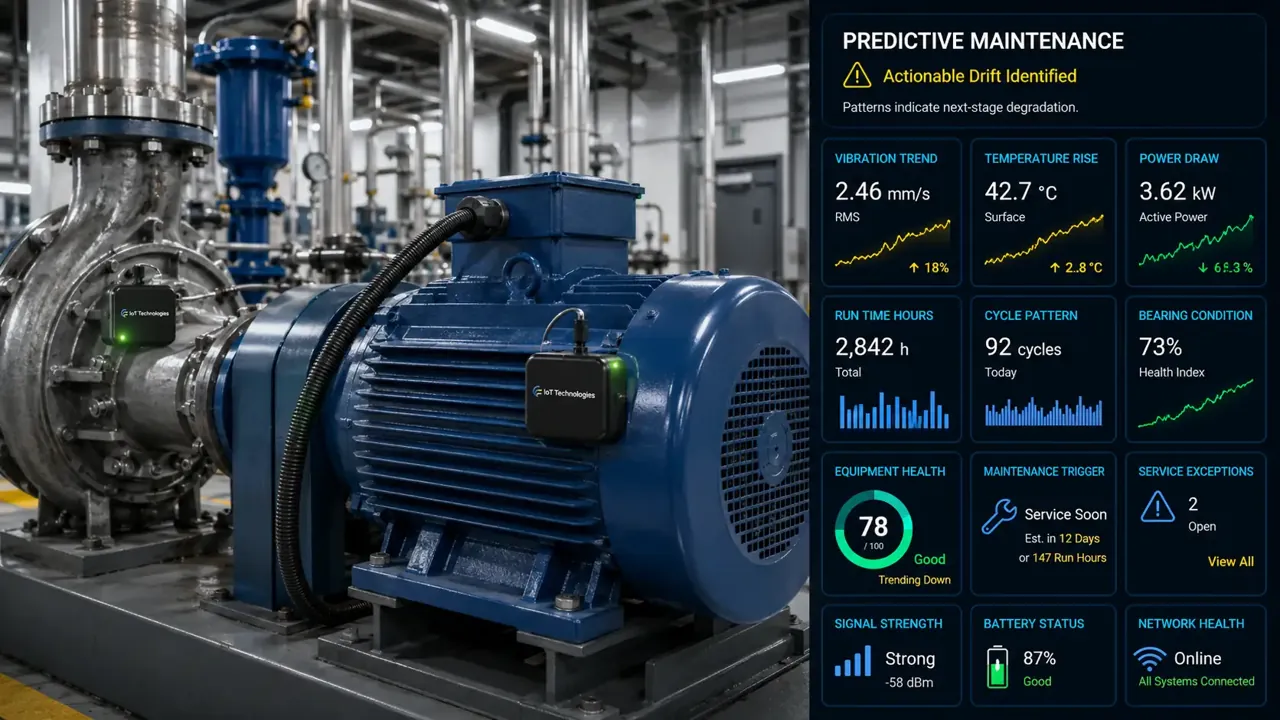
Trend drift
Surface slow changes before they become urgent failures.
Predictive maintenance looks for meaningful drift in asset behaviour, operating conditions and repeat patterns rather than waiting for a hard alarm or complete failure.
IoT telemetry, trend analysis and anomaly-led maintenance workflows that help teams detect degradation early, prioritise field intervention and reduce downtime across distributed assets and hard-to-reach sites.
IoT Technologies turns field signals into operational evidence so teams can see drift, understand risk and act before failures become expensive reactive events.

Predictive operations
Start with known asset risks, degradation modes and operational consequences instead of collecting data without a maintenance decision.
Capture vibration, temperature, current, runtime, environmental or custom signals where they support useful early-warning patterns.
Use trend drift, anomaly patterns, baselines and severity rules to create alerts teams can trust and act on.
Preserve event histories, acknowledgements and intervention outcomes so maintenance decisions can be reviewed and improved.
Predictive maintenance only works when telemetry becomes a decision. The system must show what is changing, why it matters and what action should follow.
Predictive maintenance is not a generic AI dashboard. It is the practical ability to detect a developing problem early, understand the signal in context and intervene before the result becomes downtime, cost, wasted attendance or a safety escalation.
Most organisations already have some data: sensor readings, logs, alarms, BMS outputs, inspection notes, service history or contractor reports. The problem is that the useful signal is often noisy, fragmented and disconnected from decision-making. IoT Technologies designs predictive maintenance around the full path from sensor to action.
Predictive signals often come from drift rather than a single threshold. Equipment rarely fails without warning. It warms, vibrates, cycles differently, draws power differently, runs longer, trips more often, moves out of tolerance or repeats a pattern that teams have seen before. The value is in surfacing those patterns while intervention is still cheaper and easier.
The sensing plan is shaped around the asset and the failure mode. Depending on the environment, this may include vibration, temperature, humidity, pressure, current, runtime, level, access state, digital inputs, environmental conditions or custom sensor signals. The goal is not to collect every possible data point. The goal is to capture the signals that improve maintenance decisions.
Connectivity and power are part of the design. Hard-to-reach assets, remote rooms, cabinets, plant areas, industrial spaces and distributed estates may need low-power devices, gateway buffering, cellular backhaul, Ethernet, 433 MHz or 868 MHz RF options, LoRaWAN-style profiles or mixed architectures depending on the site.
Analytics must stay operationally useful. Trend rules, anomaly detection, baselines, threshold bands and confidence scoring should reduce noise, not create a new class of false alarms. A predictive event should carry severity, asset context, evidence and suggested response so teams know whether to monitor, inspect, dispatch or escalate.
Maintenance planning improves when risk is visible early. Teams can coordinate access, spares, approvals, contractor attendance and shutdown windows before the fault becomes urgent. That reduces avoidable callouts, repeat visits and reactive downtime while giving managers better evidence for prioritising maintenance investment.
Evidence trails are essential. Predictive timelines show which asset changed, what pattern was detected, when alerts were raised, who acknowledged them and what response followed. This supports post-incident review, insurer conversations, governance, audits and continuous improvement without overclaiming guaranteed prevention.
The strongest deployments start with a focused pilot. We select representative assets, define known failure modes, capture baseline telemetry, tune rules against real behaviour, prove that alerts are meaningful and then scale the pattern across similar assets, sites and teams.

Trend drift
Predictive maintenance looks for meaningful drift in asset behaviour, operating conditions and repeat patterns rather than waiting for a hard alarm or complete failure.
Asset context
Sensors, thresholds and analytics are selected around the asset, risk, environment and maintenance decision, not around a generic dashboard template.
Anomaly detection
Baselines, trend rules, anomaly patterns and confidence scoring can help reduce false positives while preserving the alerts that require attention.
Targeted intervention
Predictive events can help maintenance teams coordinate attendance, spares, access and approvals before the problem becomes an emergency.
Hard-site telemetry
Low-power sensing, gateway buffering, cellular, Ethernet, 433 MHz, 868 MHz or LoRaWAN-style paths can be assessed around power, coverage, payload and maintenance access.
Learning loop
Intervention results, recurring faults and post-event review help refine thresholds, baselines and maintenance priorities over time.
Deployment approach
A useful predictive maintenance deployment begins with the failure mode and the operational decision that follows.
We map asset types, known failure patterns, available telemetry, maintenance workflow and site constraints, then configure sensing, connectivity, analytics and alert rules around a pilot. The pilot proves whether the signal is reliable, actionable and worth scaling.
Define assets, failure modes, degradation signals, maintenance owners, evidence needs and the decisions the system must support.
Define risk
Review access, mounting, power, telemetry sources, gateway placement, RF or network coverage and operating conditions.
Map signals
Set sensors, baselines, trend rules, anomaly bands, alert severity, acknowledgement workflow and reporting outputs.
Tune model
Run representative assets through pilot acceptance, checking signal quality, false positives, missed patterns and intervention value.
Signal proof
Extend the proven pattern across similar assets, sites, teams and contractor workflows with consistent evidence and review.
Fleet rollout
Bring the asset list, failure history, maintenance workflow, known problem patterns and site constraints. We will shape a predictive maintenance pilot around measurable early-warning value.
Plan a predictive maintenance pilotApplications
Monitor temperature, vibration, current, runtime, cycling behaviour and other degradation signals across critical equipment.
Detect abnormal patterns across production, process or support equipment where downtime affects throughput and cost.
Track drift, repeated excursions, environmental stress and equipment-support conditions across distributed building estates.
Use low-power sensing and gateway pathways where routine inspection is expensive, infrequent or operationally disruptive.
Rank issues by severity, recurrence, asset criticality and evidence so teams can focus on the interventions that matter.
Maintain timelines that show what changed, what was detected, who responded and whether the intervention reduced risk.
FAQ
It is the use of IoT telemetry, trend analysis and anomaly detection to spot equipment degradation early, so maintenance can be planned and prioritised before a developing fault becomes a reactive emergency.
Practical field signals such as temperature, current draw, runtime, vibration indicators and duty cycles, collected by low-power sensors and read against each asset's normal operating pattern.
The system learns an asset's normal behaviour from its own telemetry, then flags deviations — drift, abnormal patterns and developing changes — early enough for engineers to investigate on their own terms.
No system can honestly promise that. The value is earlier, evidence-backed warning: trends and anomalies are surfaced so teams can prioritise intervention rather than discover failure in service.
Yes. Sensors retrofit to existing plant and machinery without intrusive cabling, so condition telemetry can come from assets that were never designed to report data.
Condition monitoring shows the current state of an asset; predictive maintenance adds trend analysis and anomaly detection over time, turning that state into a forward view of which assets need attention next.
Share the assets, signals, failure modes, site constraints and maintenance workflow. We will help scope a predictive maintenance pilot with clear acceptance criteria for telemetry quality, alert value and intervention outcomes.
Direct contact
Location
Aylsham Business Park, Norwich
Norfolk NR11 6FD · VAT GB 409644484
Tell us about your assets, telemetry, degradation risks, operating conditions, alert workflow and maintenance objectives.