Transport operations with corridor and fleet visibility

IoT monitoring for rail, highways, depots and fleet operations, connecting mobile assets, roadside infrastructure, compounds, cabinets, yards and operational sites into clearer alerts, evidence records and maintenance workflows.

IoT Technologies helps transport operators and infrastructure teams see movement, access and condition signals earlier, so distributed assets and hard-to-reach sites can be managed with better evidence and fewer blind spots.

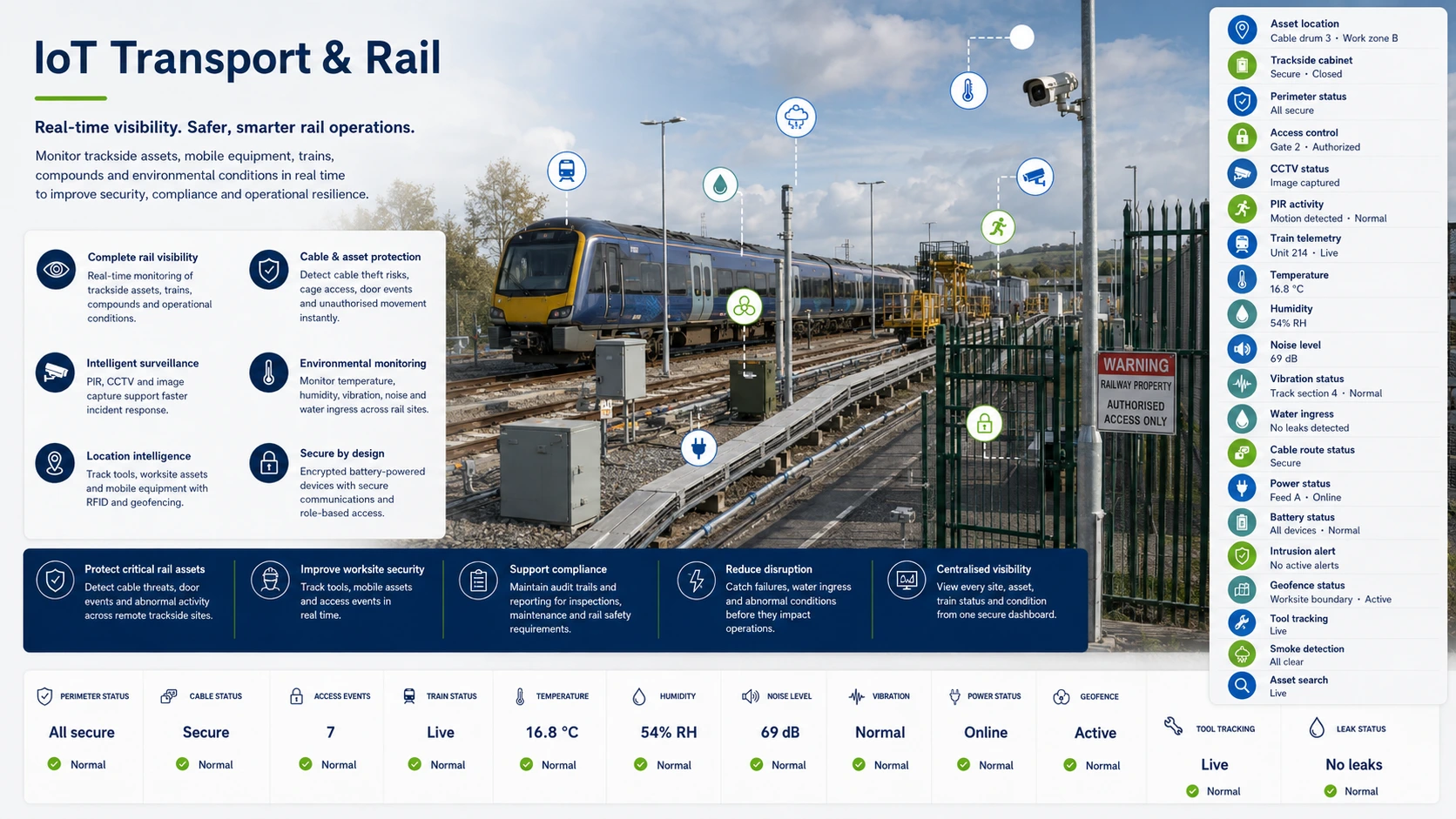
IoT Technologies transport, rail and highways monitoring — structural movement, impact, asset condition and environmental signals shown as live readings on trackside and roadside assets.

Corridor and fleet visibility

Track transport assets and infrastructure signals without confusing monitoring with safety-critical control.

Depot and fleet visibility

Track presence, movement cues, last-seen events, zone transitions and utilisation signals for mobile equipment, trailers, hired assets and operational kit.

Corridor infrastructure awareness

Monitor compounds, cabinets, gates, roadside assets, communications nodes and exposed spaces where manual checking and standard connectivity leave gaps.

Contractor and incident evidence

Preserve event histories, acknowledgements and response records that help operators, contractors and suppliers work from a shared timeline.

Safety-critical separation

Use IoT monitoring for visibility, triage and evidence support, while keeping statutory inspection, signalling, traffic management and operational safety controls separate.

Transport estates are distributed, exposed and operationally complex. Useful IoT monitoring supports visibility, triage and evidence; it does not replace safety-critical systems, statutory inspection, rail signalling, traffic management or formal operational controls.

Rail, highways and fleet environments combine fixed infrastructure with moving equipment. Depots, yards, compounds, cabinets, roadside assets, plant rooms, communications nodes, trailers, hired kit and mobile equipment often sit across wide areas with inconsistent connectivity and limited access windows.

The operational problem is visibility between inspections, patrols, service visits and contractor updates. Teams need to know whether an asset is present, whether it has moved unexpectedly, whether a restricted-area event has occurred, whether a cabinet or compound is showing abnormal access patterns, or whether environmental drift is developing before a service-impacting issue is reported.

IoT Technologies designs transport monitoring around real estate conditions. Gateways, low-power tags, sensors and secure reporting can be deployed across depots, yards, workshops, corridors, compounds, cabinets and exposed sites where cabling, mains power or asset-level SIMs may not be practical.

Fleet and depot monitoring can support asset presence, last-seen cues, utilisation patterns, zone transitions, dwell-time exceptions, recovery workflows and equipment accountability. That helps teams prioritise checks, reduce ambiguity and investigate movement events with stronger records.

Rail and highways infrastructure can benefit from exception-led telemetry around compounds, cabinets, huts, gates, power and communications nodes, roadside assets and remote operational spaces. Access anomalies, tamper cues, environmental conditions and device-health events can be routed to the right operational owners.

Environmental and plant-condition signals also matter. Temperature, humidity, moisture cues, enclosure conditions, plant-space drift and gateway health can support earlier triage in exposed or hard-to-reach locations where problems may otherwise remain hidden until a fault or site visit.

Evidence needs careful handling. Timelines, timestamps, zone events, acknowledgements, response notes and device-health records can support incident review, contractor accountability, insurer conversations and audit preparation. They support assurance; they do not guarantee compliance outcomes or replace formal transport safety processes.

The right rollout starts small. Select a depot, route section, compound group or asset class, survey coverage and mounting constraints, define useful exceptions, configure alert routing and prove that the monitoring data improves decisions before scaling across wider routes or fleets.

The result is a practical operational telemetry layer: clearer asset visibility, earlier exception signals, better evidence for reviews and stronger coordination between transport teams, suppliers, contractors and maintenance owners.

01

Depot and yard visibility

See what is present, moving or missing across transport operating sites.

Tags, sensors and gateways can support asset presence, movement cues, last-seen records, zone transitions and exception alerts across depots, yards, workshops and operational compounds.

02

Fleet and mobile assets

Support accountability for trailers, hired kit and mobile equipment.

Fleet-linked assets, tools, mobile plant, trailers and hired equipment can be monitored for location cues, dwell time, utilisation patterns, unexpected movement and recovery workflows.

03

Rail estate signals

Surface abnormal events around compounds, cabinets and route assets.

Rail-adjacent monitoring can support compound awareness, cabinet activity patterns, gate events, environmental cues and contractor evidence without replacing safety-critical railway systems.

04

Highways infrastructure

Monitor exposed roadside and remote operational assets with fewer blind spots.

Roadside cabinets, communications nodes, compounds, service areas, depots and critical support assets can feed exception-led alerts and condition records to operational teams.

05

433 MHz and 868 MHz

Design coverage around harsh sites, long routes and hard-to-reach spaces.

433 MHz, 868 MHz, gateway-led and mixed telemetry approaches can be assessed around metalwork, enclosures, compounds, depots, cabinets, service corridors and remote sites where coverage matters.

06

Evidence and governance

Keep transport event records clear without overclaiming safety or compliance outcomes.

Timelines, timestamps, acknowledgements, response notes and device-health records can support audit preparation, incident review, supplier accountability and insurer conversations while formal duties remain process-specific.

Deployment approach

Start with one route section, depot group or asset class before scaling.

Transport monitoring should prove coverage, alert usefulness and evidence value in representative conditions before expanding across routes, depots, fleets or contractor groups.

We define the asset classes, corridor estate, depot workflow, access constraints, response owners and reporting outputs, then survey mounting, power, gateway placement, RF coverage and data handoff. Tags, sensors, thresholds, alerts and reports are configured around a focused pilot before scaling.

Scope

Define fleet, depot, corridor, cabinet, compound, roadside, asset, contractor, governance and reporting priorities for the pilot.

Set priorities

Survey

Check depots, yards, compounds, cabinets, enclosures, route assets, metalwork, mounting positions, power options, gateway placement and RF constraints.

Map coverage

Configure

Set tags, sensors, cadence, thresholds, zone rules, movement exceptions, alert routes, acknowledgements, device-health checks and reports.

Tune events

Prove

Run a representative pilot, validating signal quality, event usefulness, contractor handover, evidence records and operational response workflow.

Pilot proof

Scale

Extend the proven pattern across additional routes, depots, fleets, asset classes, contractor groups and reporting teams.

Portfolio rollout

Bring the route, depot, fleet or infrastructure scope, known blind spots, contractor workflow, coverage constraints and evidence requirements. We will shape a pilot around signal quality, operational usefulness and reporting value.

Plan a transport monitoring pilot

Applications

Where transport telemetry improves visibility, response and evidence.

Rail compounds and cabinets

Support visibility around compounds, cabinets, gates, huts, communications nodes and restricted operational spaces with careful safety-critical separation.

Highways roadside infrastructure

Monitor cabinets, roadside assets, compounds, service locations, communications nodes and exposed infrastructure where manual inspection is limited.

Depots, yards and workshops

Track asset presence, movement cues, dwell-time exceptions, environmental conditions and gate or compound events across operational sites.

Fleet, trailers and hired equipment

Improve accountability for mobile equipment, trailers, tools, hired kit and high-value assets moving between depots, routes and field operations.

Remote plant and environment

Add temperature, humidity, moisture, enclosure-condition and device-health signals where drift can indicate developing risk.

Contractor and incident review

Maintain shared timelines, response notes, acknowledgements and reporting outputs for supplier review, governance and incident analysis.

FAQ

Frequently asked questions

What does transport IoT monitoring cover?

Depots, yards, roadside infrastructure, compounds, cabinets and fleet assets across rail, highways and logistics operations — movement, access and condition signals turned into alerts and evidence records.

How are assets monitored in transit?

Through condition telemetry: temperature, humidity, motion, tamper and impact readings travel with the asset and surface exceptions, so what happened in transit is evidenced rather than argued about.

Is this a safety-critical or rail signalling system?

No. It is a monitoring and evidence layer that is separate from and complementary to safety-critical control, signalling and traffic management systems, and it never replaces statutory inspection.

How does it cover hard-to-reach transport sites?

Battery-powered sensors and sub-GHz radio at 433 MHz and 868 MHz reach lineside cabinets, remote compounds and roadside assets without mains power or reliable cellular coverage.

What evidence does it produce?

Time-stamped event and condition histories across depots, corridors and fleets that support maintenance planning, supplier accountability and governance review.

Make transport assets
more visible, evidenced and accountable.

Share the operating environment, asset classes, corridor estate, depot workflow, coverage constraints and evidence needs. We will help scope a practical transport monitoring pilot with clear acceptance criteria for signal quality, alert usefulness, response workflow and reporting value.

Location

Aylsham Business Park, Norwich

Norfolk NR11 6FD · VAT GB 409644484

Transport monitoring enquiry

Tell us about your rail, highways, depot, fleet, corridor, roadside, cabinet, compound or mobile-asset monitoring requirements.

No mailing lists. No spam. We reply directly to your enquiry.