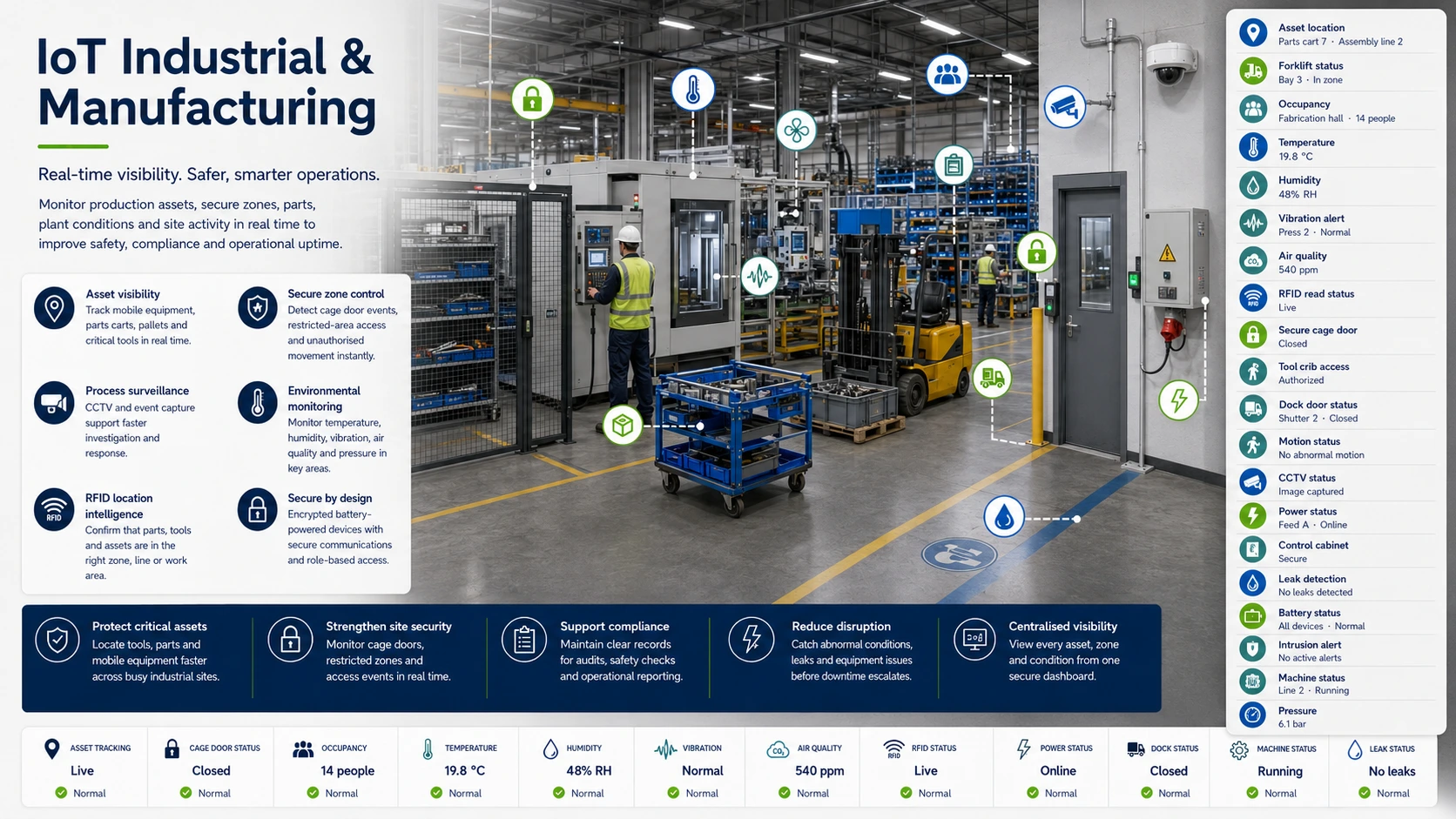
Industrial monitoring works when it gives teams dependable signals from difficult environments and turns those signals into maintenance decisions, not more noise.
Industrial and manufacturing environments are built for throughput, process control and safety, not always for retrofit visibility. Assets move, machinery vibrates, temperatures shift, dust and humidity interfere, and minor faults can become expensive downtime when they are discovered late.
Many industrial sites contain hard RF conditions, metalwork, restricted areas, shift-based access, safety procedures, permit requirements and equipment that was never designed to be instrumented after the fact. A useful monitoring layer has to work around those realities rather than assuming ideal connectivity or easy cabling.
IoT Technologies designs industrial IoT monitoring around the operational decision. That may be a vibration trend, temperature drift, current change, runtime pattern, abnormal movement, access event, environmental exposure, equipment state, liquid level, pressure signal or custom input that helps teams intervene earlier.
Connectivity is engineered around the plant. Depending on distance, shielding, payload, power and gateway placement, deployments may use 433 MHz, LoRaWAN-style profiles, cellular, Ethernet, Wi-Fi where appropriate or mixed gateway architectures. Where a plant already operates 868 MHz equipment, the deployment can integrate with it.
Low-power and non-intrusive deployment matter. Many useful sensing points are difficult to cable, unsafe to access frequently or disruptive to retrofit. Battery devices, suitable cadence, gateway buffering and device-health visibility help keep monitoring practical without forcing shutdowns.
The value comes from exception signals. Teams do not need another stream of raw readings. They need high-signal events that identify thermal drift, environmental exposure, abnormal movement, restricted-zone activity, equipment change or a developing maintenance risk.
Industrial telemetry should also support existing workflows. Alerts, dashboards, exports, APIs and maintenance records need to fit the teams responsible for response, safety, compliance, production and contractor attendance.
Evidence-grade timelines help after incidents and near misses. Records of what changed, when it changed, who was alerted, whether the device and gateway were healthy and what response followed support investigation, audit, maintenance planning and continuous improvement.
The strongest industrial IoT solutions start with a focused pilot. We identify critical assets and failure modes, survey coverage and power, define actionable events, prove signal quality and then scale the pattern across lines, buildings, equipment groups or multi-site portfolios.