
Insights
Why 433 MHz reaches a water meter underground when 868 MHz can't
5 min read
Reading a water meter that sits in a lidded, often flooded chamber below the pavement is one of the hardest jobs in field telemetry, and the radio band you choose decides whether the read ever gets out. Lower-frequency 433 MHz loses less energy passing through soil, water and a chamber lid than 868 MHz, so a small one-way meter read is far more likely to reach a receiver above ground. The usual objections to 433 — larger antenna, lower transmit power, lower data rate — barely register for metering, because the reads are tiny and infrequent.
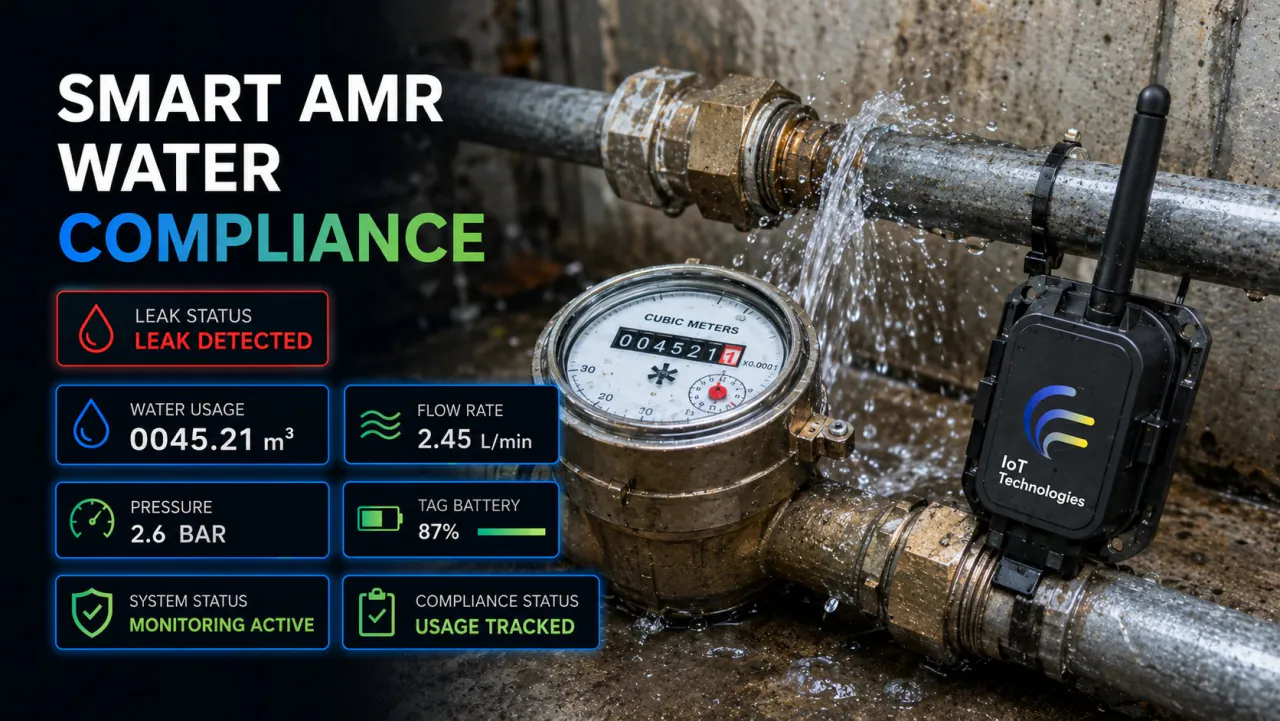
01
The problem: a meter in a hole
Most water meters live exactly where no one would choose to put a radio: inside a concrete or composite chamber under a footpath or verge, behind a metal or reinforced lid, frequently half-full of water for part of the year. Every one of those is hostile to radio. Soil attenuates the signal, water absorbs it aggressively, and the lid acts as a partial shield. The meter has to push a small reading from inside that box to a receiver above ground, reliably, on a battery that has to last years. Get the radio wrong and you do not get a slightly worse read — you get no read at all, and a van visit to find out why.
02
It's physics, not marketing: lower frequency, deeper reach
Radio loss rises with frequency. The higher the frequency, the more energy a signal sheds as it passes through soil, water and building materials, which is precisely the path a buried meter's signal must take. That single fact is why 433 MHz outperforms 868 MHz below ground: at the lower frequency, more of the signal survives the trip out of the chamber.
The realistic link is underground-to-aboveground. The meter transmits upward to a collector or gateway at street level or on nearby infrastructure, rather than trying to talk meter-to-meter through the ground. Field studies of buried low-power radios report usable underground-to-aboveground ranges into the hundreds of metres depending on soil type, moisture and burial depth — comfortably enough for a meter a few tens of centimetres down talking to a local gateway. Antenna placement and orientation matter more than people expect; a few centimetres or a few degrees can be the difference between a clean read and silence.
03
The case for 868 MHz
868 MHz is not a bad band. It is just the wrong default for this job. It has a larger European device ecosystem, supports a higher transmit-power ceiling, allows higher data rates and needs only a small antenna, which is why so much low-power wide-area equipment defaults to it. For sensors above ground with a clear path to a gateway, it is an entirely sensible choice.
Underground, its advantages stop mattering and its disadvantages start. The higher data rate is irrelevant when the payload is a meter reading a handful of bytes long. The smaller antenna is no help when the signal cannot escape the chamber in the first place. And in the UK the 868 MHz band is busy — shared with alarms, RFID and a wide range of short-range devices — with duty-cycle limits that cap how often a device may transmit. More noise and a tighter transmit budget are the last things you want when you are already fighting soil and water for every decibel.
04
The case for 433 MHz
433 MHz is also licence-exempt in the UK, designated by Ofcom as a short-range-device band alongside 868. Its lower frequency buys deeper penetration through the ground, the chamber and surrounding clutter, and in the UK it is far less congested than 868 — a cleaner channel and fewer collisions.
The trade-offs are real but, for metering, academic. A 433 MHz antenna has to be physically larger to match the efficiency of an 868 MHz one, and the European maximum transmit power is lower. Neither hurts a water meter: there is room in a chamber for a sensible antenna, and the read is so small and so occasional that low power and a low data rate are non-issues. You are trading throughput you do not need for penetration you absolutely do.
05
Why it nets out for automated meter reading
Automated meter reading is the ideal workload for 433 MHz. The meter sends a small reading on its own schedule — once a day, once an hour, whatever the application needs — in one direction, up to a receiver. There is no large file to move, no live stream, no constant chatter. What matters is that each small, infrequent read gets out of a difficult location every time, on a battery measured in years.
That is why IoT Technologies runs primarily on 433 MHz and keeps 868 available for compatibility where it makes sense. It is a deliberate engineering choice, made for the environments that actually matter — pits, basements, plant rooms and underground chambers, not open fields. The result is meter reads that arrive reliably from places higher-frequency networks struggle to reach, and far fewer wasted visits chasing the ones that do not.
06
What this means for your estate
If you are reading water meters across a portfolio, or planning to, the band your network uses is not a technical footnote. It is the difference between data you can bill and audit against and gaps you have to send someone out to fill.
FAQ
Frequently asked questions
Does 433 MHz reach underground better than 868 MHz?
Yes. Radio loss increases with frequency, so the lower 433 MHz band loses less energy passing through soil, water and chamber lids, making it more reliable for meters below ground.
Why are underground water meters hard to read wirelessly?
They sit in chambers behind metal or concrete lids, often partly flooded. Soil attenuates radio, water absorbs it, and the lid shields it, so the signal struggles to escape to a receiver above ground.
Is 433 MHz licence-free in the UK?
Yes. Ofcom treats 433 MHz as a licence-exempt short-range-device band, as it does 868 MHz; both can be used without an individual licence, subject to the usual conditions on power and channel access.
What frequency is best for automated water meter reading?
For meters in below-ground chambers, 433 MHz is usually the better choice, because penetration matters far more than data rate for small, infrequent, one-way reads.
Does a 433 MHz meter need a bigger antenna?
A 433 MHz antenna is larger than an 868 MHz one for the same efficiency, but there is normally room in a meter chamber, and the penetration gain outweighs the size cost.