Real-time emissions monitoring across every commercial kitchen extract

Grease, particulate and air-quality limits on kitchen extract become an operator's problem the moment a filter fails or a neighbour complains. We make it visible in real time across every site — and turn it into the evidence that supports your compliance.

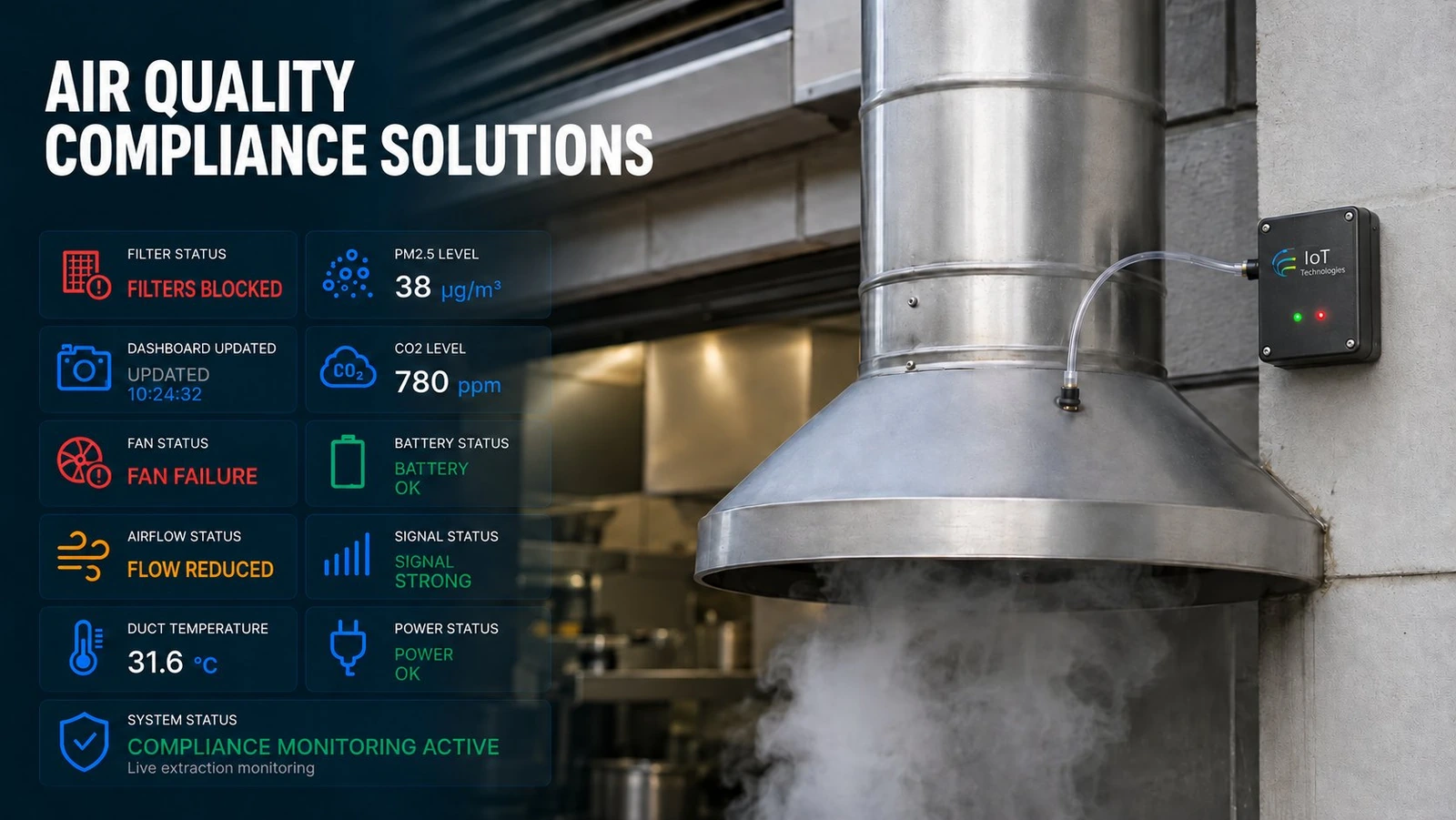
A retrofit monitoring layer for commercial kitchen extract, configured to each site. We fit a unit at the discharge, monitor the signals that matter — grease and particulate, PM2.5, CO2, airflow, fan and filter status, duct temperature — turn anything trending the wrong way into an instant alert, and log it as compliance-ready evidence for the teams who run QSR and restaurant estates.

IoT Technologies commercial kitchen extract emissions monitoring — a retrofit sensor unit on a kitchen extract duct with a live dashboard showing filter, particulate, fan and airflow status

How it works

Air-quality and emissions monitoring, configured to your kitchens.

Retrofit at the discharge

A small monitored unit fits at the extract exhaust with a probe in the airflow — no major works — and reads continuously.

Configured to each site

The monitored set is matched to the kitchen — grease and particulate, PM2.5, CO2, airflow, fan and filter status, duct temperature — so different sites and cooking loads get the right sensing.

See filters fail early

A degrading filter shows as a rising trend, so it becomes a planned change rather than a complaint, an overdue clean or a failed inspection.

Compliance evidence, one dashboard

Real-time status and trends across every site on a single view, alerts routed by site and team, and a timestamped record that supports planning conditions, environmental-health discussions and your compliance.

We do not replace your filters or your cleaning regime. We fit a retrofit unit at the extract discharge, monitor the signals each site needs, and put every kitchen across the estate on one live view — with the evidence to support your compliance.

Every commercial kitchen vents grease, particulate and odour through its extract. Get it wrong and the consequences are practical and expensive: blocked filters and ductwork, planning and environmental-health attention under the DEFRA odour and noise guidance, and a buildings-insurance expectation that the system is maintained. The hard part for an operator is not knowing the rules — it is knowing, across dozens or hundreds of sites, which kitchens are drifting out of line right now.

We add a retrofit monitoring unit at the extract discharge — a small enclosure outside the building at the exhaust, with a probe in the airflow. The monitored set is configured to each site: grease and particulate, PM2.5, CO2, airflow and fan status, filter condition and duct temperature. It reads continuously, so a degrading filter or a rising emission shows as a trend long before it becomes a complaint or a failed inspection.

The moment a reading crosses a threshold, that event is pushed as a real-time alert and the site's status updates on a live dashboard. Routing is shaped around how the estate is run — by site, region, team and escalation path — so a kitchen quietly venting over the limit reaches the person who can act, instead of surfacing as an environmental-health letter weeks later.

It is built for retrofit and for scale. The units are low-cost to install with no major works, designed for long service life, and the same architecture runs a single restaurant or a national estate of kitchens on one consistent feed, with a timestamped record throughout.

It is the live air-quality and compliance evidence layer for your kitchen estate. It tells you when something is trending the wrong way, gives you a timestamped history to act on and to show, and works alongside the cleaning and filtration you already run — supporting your obligations under the relevant guidance rather than leaving you to find out after the fact.

01

The blind estate

Dozens of kitchens venting, and no live view of which are drifting.

Operators run extract systems site by site and rely on periodic cleaning and inspection. Between visits there is rarely any real-time picture of which kitchens are pushing grease and particulate over the line — until a neighbour, a planning officer or an inspector raises it.

02

Early warning

A failing filter should be a planned change, not a complaint.

Continuous monitoring catches the upward trend in emissions as a filter degrades, so the fix is scheduled on the data rather than triggered by a problem that has already left the building.

03

Compliance evidence

A logged history that supports your compliance.

Every reading and alert is timestamped and retained, giving operators a trend record that supports maintenance decisions, planning conditions and discussions with environmental health.

Deployment route

From periodic cleaning to live emissions visibility

A practical route from kitchen-extract brief to live monitoring — covering the discharge points, unit retrofit, thresholds, alert routing and estate rollout.

The process is specific to kitchen extract: understand the sites and cooking loads, fit the monitoring units at the discharge, set sensible thresholds and alert routes, prove it in the field, then scale across the estate.

Discuss

Map the estate: number of sites, cooking types and loads, current cleaning and filtration regime, and who needs to know when a kitchen drifts.

Estate brief

Survey

Profile the extract discharge points, unit mounting, power and the connectivity at each site.

Site profile

Retrofit

Fit the monitoring units at the exhaust with no major works, and configure the sensor set, thresholds, dashboard views and alert routing.

Units fitted

Prove

Run a controlled period to confirm readings track real cooking loads, alerts fire correctly and thresholds are sensible.

Pilot proven

Scale

Roll the monitoring layer out across the estate, with status, alerting, reporting and the trend record built in.

Estate rollout

Running kitchen extract across a QSR estate, restaurant group, pub chain or hospitality portfolio?

Book a site survey

Where it applies

Built for kitchen estates where air-quality compliance becomes someone else's problem fast

QSR and fast-food chains

High-throughput kitchens where heavy cooking loads push grease and particulate hard between cleans.

Restaurants and pubs

Single sites and groups where a planning condition or a neighbour complaint can put the extract under scrutiny.

Hospitality FM and caterers

Contractors running extract across many client kitchens who need one view and a defensible record.

Estates near residential

Sites where odour and particulate limits are tightest and evidence matters most.

FAQ

Frequently asked questions

What is commercial kitchen extract monitoring?

It is a retrofit unit at the extract discharge that monitors grease and particulate levels, PM2.5, CO2, airflow, fan and filter status and duct temperature in real time, raising an alert when anything trends the wrong way.

Why monitor kitchen extract emissions?

Because extract problems surface as odour complaints, neighbour disputes and enforcement pressure long after the underlying filter or fan issue began — monitoring makes the problem visible while it is still cheap to fix.

How does it detect a failing filter?

Airflow, pressure behaviour and particulate trends change as a filter loads or fails; the system reads those signals continuously and alerts before performance collapses or grease carry-over builds up.

Can it help with compliance?

It produces time-stamped readings, exception records and maintenance evidence that support your compliance position with landlords, environmental health and insurers — it does not certify compliance by itself.

Does it work across multiple sites?

Yes. Every kitchen reports into one estate dashboard, so operators see which sites are healthy, which are trending the wrong way and where maintenance budgets should go first.

Ready to see
every kitchen extract

on one dashboard?

Tell us how many sites you run and your current cleaning and filtration setup. We will shape a practical pilot that puts the estate on one live view.

Location

Aylsham Business Park, Norwich

Norfolk NR11 6FD · VAT GB 409644484

Talk to a monitoring engineer

Tell us about your sites, cooking loads, current extract setup and how alerts need to reach your teams. An engineer will review it.

No mailing lists. No spam. We reply directly to your enquiry.