Real-time weather and structural monitoring for masts and towers

Operators run expensive masts and towers they cannot see the condition of between inspections. We put a wireless station on the structure that reads the real conditions around it — and tells you the moment something moves.

A retrofit monitoring station that reads sway, vibration and movement alongside wind, temperature, humidity, barometric pressure and lightning or lateral-shock events — turning an abnormal reading into an instant alert and building the condition record behind maintenance, warranty and insurance. Battery-powered, movable, every structure on one dashboard.

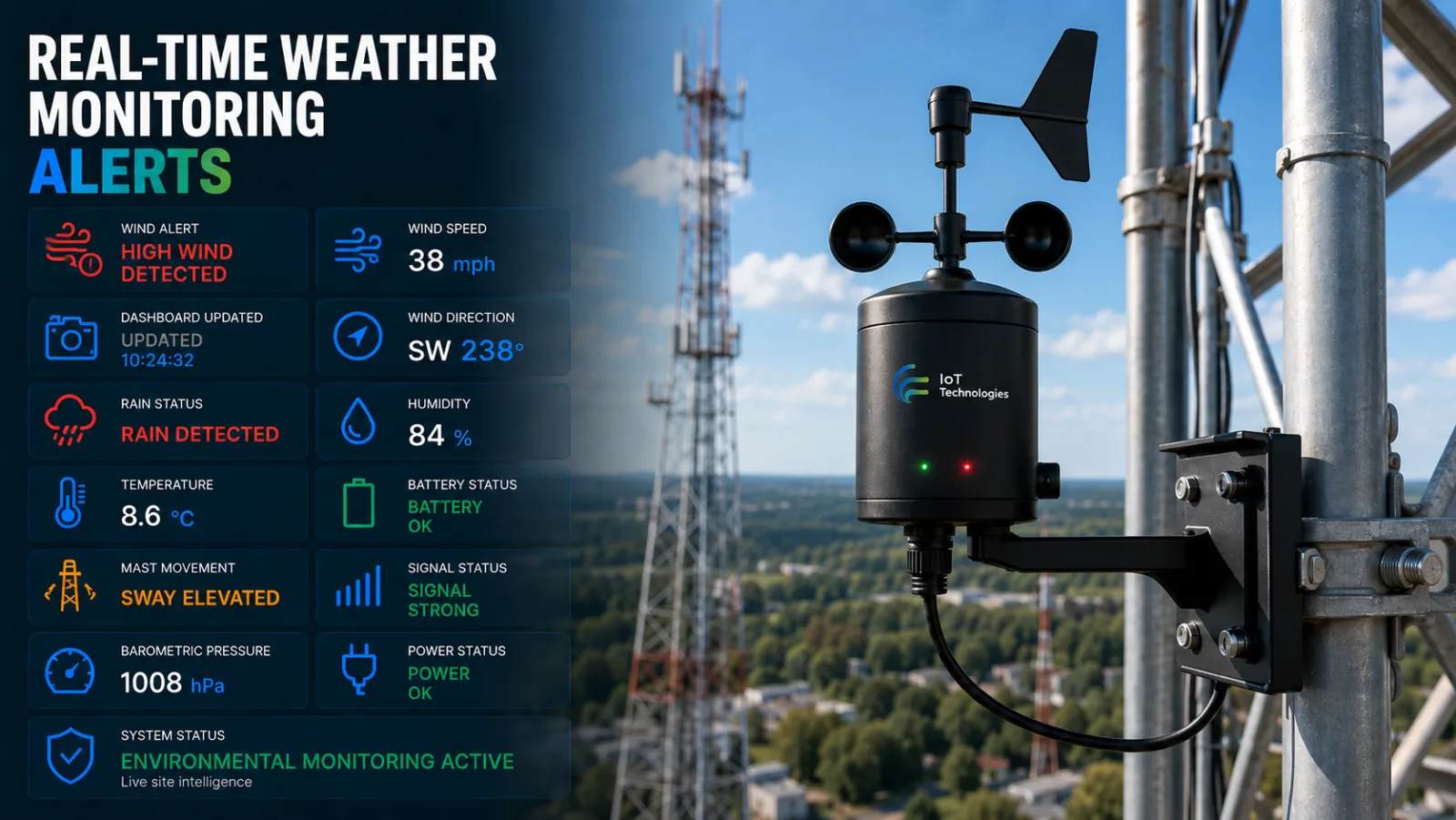
IoT Technologies mast and tower monitoring — a retrofit wireless weather and sway sensor on a telecoms tower with a live dashboard showing wind, sway, vibration and strike alerts

How it works

Condition intelligence around the structures you cannot easily inspect.

Reads the mast, not just the weather

Sway, tilt and vibration of the structure itself, alongside wind, temperature, humidity and barometric pressure — and discrete events such as lightning strikes and lateral shocks.

Instant sway and wind alerts

An abnormal movement, a high-wind threshold or a strike becomes a real-time alert and a status change — not something found on the next climb.

A condition record per structure

Every reading and event is timestamped and retained, building the profile behind maintenance planning, post-storm review and warranty and insurance conversations.

Retrofit, battery, movable

Clamps on without wiring in a single visit, multi-year battery, low cost — and follows the structures that matter rather than fixing you to one install.

We do not replace your structural inspections. We retrofit a wireless station to the mast, read the conditions around it continuously, and put every structure on one live view — with an instant alert the moment sway, wind or a shock crosses its threshold.

A mast or tower is one of the most expensive things on a site and one of the hardest to keep eyes on. Between scheduled inspections, owners have little idea how the structure is actually behaving — how much it sways in high wind, whether vibration is creeping up, or whether it took a lightning strike or a knock overnight. The conditions that wear a structure out happen continuously; the visibility does not.

We close that gap with a wireless station retrofitted to the structure. It reads the movement of the mast itself — sway, tilt and vibration — alongside the weather driving it: wind speed and direction, temperature, humidity and barometric pressure. It also flags discrete events such as lightning strikes and lateral shocks. Because it is battery-powered and clamps on without wiring, it goes up in a single visit, and because it is movable it follows the structures that matter.

The instant a reading crosses its threshold — sway beyond its normal envelope, wind above a set limit, a strike or a sharp movement — that event is pushed as a real-time alert and the structure's status updates on the dashboard. Routing is shaped around how the estate is run, by site, region and team, so an abnormal mast reaches the person who can act rather than waiting for the next climb.

Every reading and event is timestamped and retained, building a condition profile for each structure over time. That record is what turns a mast from a black box into something with a history — supporting maintenance planning, root-cause review after a storm, and the warranty and insurance conversations around assets that often carry surprisingly short guarantees.

It is the live condition layer around your structures, running on retrofit, low-cost hardware across a single mast or a national estate on one consistent feed. It complements your structural inspection and engineering regime; it does not replace them, and it is a monitoring and evidence system rather than a structural-safety guarantee.

01

The black box

An expensive structure you cannot see the condition of between inspections.

Owners rely on scheduled climbs and a structure that looks fine from the ground. Between visits there is rarely any picture of how a mast is actually behaving — how it sways in wind, whether vibration is rising, or whether it took a hit overnight.

02

Movement, instantly

Abnormal sway or a strike should reach a person, not wait for the next climb.

When the structure moves beyond its normal envelope, the wind crosses a limit, or a strike or lateral shock lands, the event is captured and pushed as a real-time alert — routed by site, region and team — so it is acted on immediately.

03

The condition record

A history per structure that stands up for maintenance and insurance.

Every reading and event is timestamped and retained, giving a condition profile that supports maintenance planning, post-incident review and the warranty and insurance case around assets with short guarantees.

Deployment route

From a black-box mast to its conditions on one dashboard

A practical route from structure brief to live monitoring — covering the masts, station mounting, thresholds and alert routing, and estate rollout.

The process is specific to masts and towers: understand the structures and their normal envelopes, mount the wireless stations, set sway, wind and event thresholds and alert routes, prove it in the field, then scale across the estate.

Discuss

Map the structures, their normal movement and wind envelopes, who needs to know when one moves and how cover works.

Structure brief

Survey

Profile the masts, station mounting points, gateway placement and the RF conditions across the sites.

Site profile

Retrofit

Clamp the wireless stations to the structures with no wiring, and configure thresholds, dashboard views and alert routing.

Stations fitted

Prove

Run a controlled period to confirm readings track real conditions, thresholds are sensible and alerts fire and route correctly.

Pilot proven

Scale

Roll the monitoring layer out across the estate, with status, alerting, reporting and the condition record built in.

Estate rollout

Running masts, towers or other exposed structures across a portfolio?

Book a site survey

Where it applies

Built for the exposed structures that are expensive to climb and costly to lose

Telecoms masts & towers

Sway, vibration, wind and strike intelligence around the structures carrying your network.

Rooftop & monopole sites

Movement and wind exposure on structures where access is hard and climbs are costly.

Energy & transmission structures

Towers and lines exposed to wind, ice loading and movement across remote routes.

Temporary & structural works

Cranes, temporary masts and structures under construction where movement and sway matter most.

FAQ

Frequently asked questions

What is mast and tower monitoring?

It is a retrofit wireless station on the structure that reads sway, vibration and movement alongside wind, temperature, humidity, barometric pressure and lightning or lateral-shock events, raising an instant alert the moment something moves.

What does it tell us between inspections?

A continuous condition record. Instead of two snapshots a year, operators see how the structure actually behaves through storms, temperature cycles and day-to-day service.

How does it detect structural movement?

Sway, vibration and lateral-shock readings are compared against the structure's own baseline behaviour, so genuine movement and impact events stand out from normal wind response.

Does it need power at the mast?

No mains supply is required. The station is engineered for low-power operation on structures without spare power, reporting over long-range radio.

Can the data support warranty and insurance conversations?

Yes. The condition record evidences what the structure experienced and when — wind loading, shock events, movement history — which supports maintenance decisions, warranty discussions and insurance processes.

Does it replace structural inspections?

No. It complements the inspection regime by flagging when something has changed, helping engineers prioritise which structures to visit and what to look at when they get there.

Ready to see
what's happening around

your masts?

Tell us about the structures, their normal movement and wind envelopes and how many you run. We will shape a practical pilot that puts them on one live view.

Location

Aylsham Business Park, Norwich

Norfolk NR11 6FD · VAT GB 409644484

Talk to a monitoring engineer

Tell us about the masts or towers, the conditions you need to watch and how alerts need to reach your teams. An engineer will review it.

No mailing lists. No spam. We reply directly to your enquiry.