Cabinet & site monitoring for telecoms cabins, cabinets and remote sites

Real-time monitoring for telecoms cabins, equipment cabinets, comms rooms and unmanned remote sites — temperature, humidity, mains and battery power, door and access, movement and intrusion — turned into instant alerts and one live dashboard.

We retrofit low-power monitoring into the cabins, cabinets and remote sites you already run, so the conditions that take a site offline — a power dip, a thermal climb, an open door, an intrusion — are seen and alerted the moment they happen, not on the next site visit.

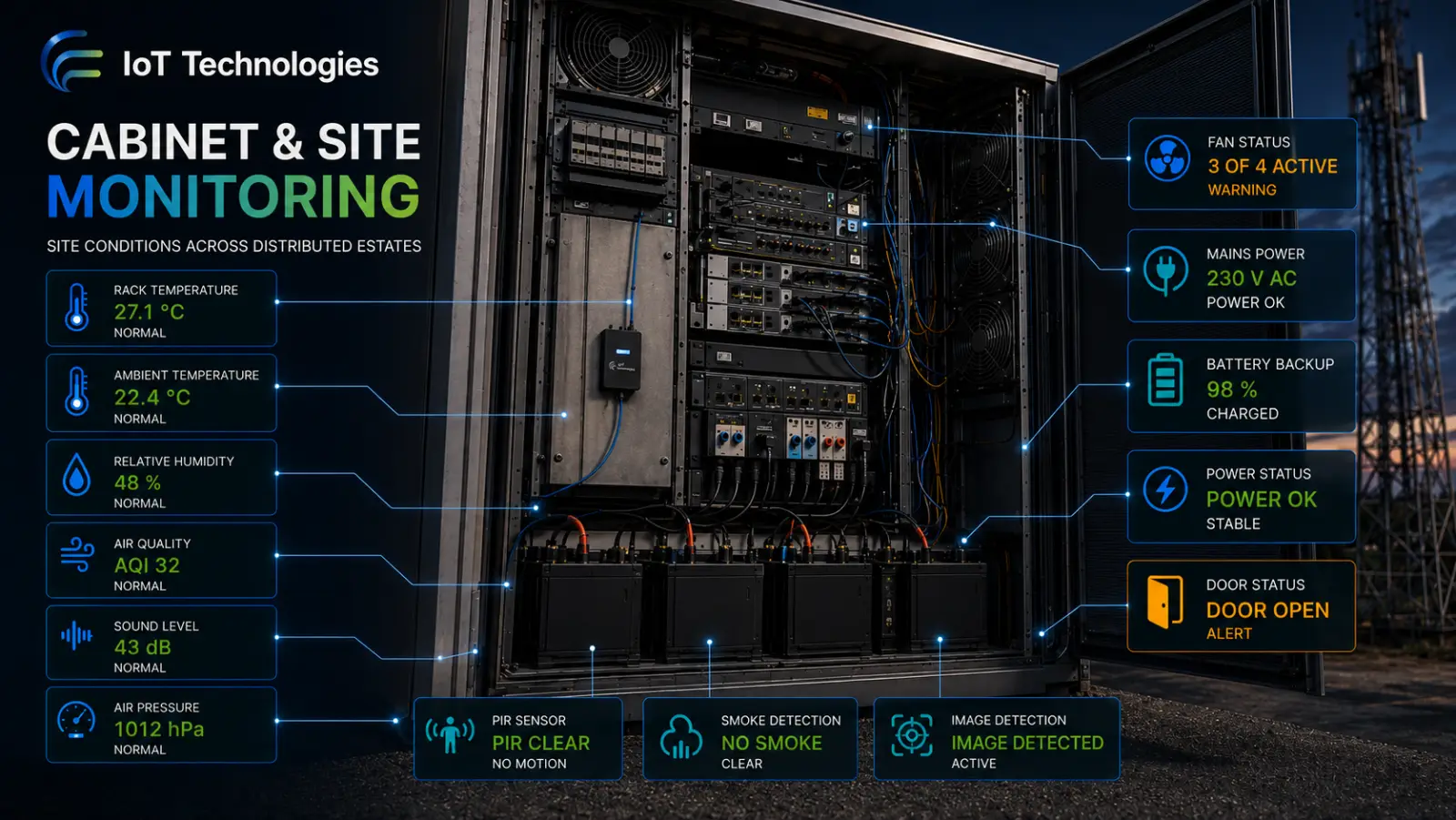
Illustrative IoT cabinet and site monitoring dashboard showing rack temperature, ambient temperature, humidity, mains and battery power, door status, movement and equipment health for a telecoms cabin

What we deploy

Real-time site conditions, configured to the site.

Retrofit into sites you already run

A low-power ZARC Node fits the cabins, cabinets and enclosures already on site — IP-rated, long battery life and low installed cost, so coverage scales across an estate without a capital project.

The conditions that take a site down

Rack and ambient temperature, humidity, mains and battery power, fan and equipment status, door and movement — monitored continuously and configured to the site, not a generic template.

One-way telemetry, real-time alerts

Readings report out to the platform and trip instant alerts by condition, site and time of day, routed to dashboard, SMS, email or nominated teams with escalation on non-acknowledgement.

Evidence trail for every event

Power loss, an out-of-hours door event or a thermal excursion is timestamped and logged for audit, claims and post-incident review across the estate.

One-way telemetry from the cabinet or remote site to instant alerts and a live dashboard — from a single telecoms cabin to a distributed estate on the same architecture.

The system is built for retrofit. A low-power ZARC Node fits inside the cabin, cabinet or enclosure you already operate — no structural change, no rip-and-replace, no rewiring the site to fit a generic template. That suits telecoms cabins and compounds, equipment cabinets, comms rooms, plant spaces and the unmanned remote sites that rarely get a human visit.

It monitors the conditions that actually take a site down: rack and ambient temperature, humidity, mains and battery power, fan and equipment status, door and access state, and movement or intrusion. Each deployment is configured to the site rather than assumed, so the readings and thresholds reflect what matters at that location.

Telemetry is one-way. The node reports its readings out to the platform over low-power radio, where thresholds turn them into events. There is no remote command path and no streaming of images or video — this is a monitoring and alerting layer, not a control system.

Catching a condition is only half the job; the alert has to arrive. Routing is shaped around the operating model — condition type, site, time of day and who is on cover — and pushed to dashboard, SMS, email or nominated teams, with escalation if it is not acknowledged. Every event is timestamped and logged, so a power loss, a door opened out of hours or a temperature excursion holds up afterwards as an evidence trail.

Battery life is engineered against reporting cadence and site conditions, with devices designed for multi-year service so maintenance overhead does not kill a rollout before it scales. The same system runs a single proof site or an estate-wide deployment without losing the audit trail.

Where fire, smoke or gas are in scope, the system complements existing life-safety detection rather than replacing it — readings are raised as alerts to support a response, never as a substitute for certified fire or life-safety systems.

01

Unmanned sites

Remote sites that fail unseen between visits.

Cabins, cabinets and remote sites rarely get a human eye on them. A power dip, a failing fan, a thermal climb or an open door can run for days before anyone knows — continuous telemetry flags it the moment it happens.

02

Operational routing

Alerts that need to reach the right person, fast.

Cover patterns differ by site and time. Alerts can be routed by condition, site, zone and out-of-hours schedule so teams get an actionable notification rather than alarm noise — with escalation if no one acknowledges.

03

Power and access

Power and door events that need to be caught in real time.

Mains loss, battery drain, an open or forced door and movement on site are first-class events, not footnotes — surfaced and logged so isolation, dispatch and investigation can start early.

Deployment route

Discuss your cabinet and site monitoring, then deploy it properly

A practical route from site brief to live monitoring — covering the node, what it senses, alert schedules, dashboard configuration and estate rollout.

The process is specific to cabinet and site monitoring: understand the sites, fit the right device, configure the alert paths, prove the behaviour in the field, then scale with evidence.

Discuss

Discuss your cabinet and site monitoring requirements: site types, what is inside the cabinets, power arrangements, access and security needs and response cover.

Site brief

Survey

Profile the cabins, cabinets and remote sites — assets, power, access points, radio conditions and the conditions worth alerting on at each location.

Site profile

Configure

Configure the node sensing, dashboard views, SMS and email notifications, thresholds, schedules and escalation rules to the site.

System configured

Prove

Run a controlled proof site to test signal quality, thresholds, false-alarm behaviour and the response workflow before scaling.

Proof site

Scale

Roll out across the estate, with monitoring, alerting, support and reporting built in and a consistent audit trail.

Estate rollout

Have telecoms cabins, equipment cabinets or unmanned remote sites that need real-time monitoring?

Discuss cabinet & site monitoring

Where it applies

Designed for places where water damage becomes expensive quickly

Telecoms cabins & compounds

Real-time temperature, power, door and intrusion visibility for cabins and compounds that sit unmanned between visits.

Equipment cabinets & comms rooms

Environmental and power monitoring for cabinets and comms rooms where a thermal or power fault risks the kit inside.

Data centre support spaces

Continuous conditions and access visibility for edge and support spaces around critical infrastructure.

Remote & unmanned sites

Estate-wide visibility for distributed sites where a site visit is expensive and a missed fault is costly.

FAQ

Frequently asked questions

What is cabinet and site monitoring?

It is retrofit monitoring for telecoms cabins, equipment cabinets, comms rooms and unmanned remote sites, covering temperature, humidity, mains and battery power, door and access events, movement and intrusion — alerted the moment they happen.

What conditions take a remote site offline?

Most outages start as a power dip, a thermal climb, a failed fan, an open door or an intrusion. Monitoring surfaces each of those the moment it starts, instead of on the next site visit.

Does it need mains power or a network connection at the site?

No. Battery-powered sensors report over low-power sub-GHz radio to a gateway, so cabinets and huts without spare power or connectivity can still be monitored.

How do door and access events work?

Door open and close events are timestamped and matched against expected work windows, so unexpected access — out of hours or at an unattended site — raises an immediate alert.

Can one dashboard cover the whole estate?

Yes. Every cabin, cabinet and site reports into a single live view with per-site status, alert history and the evidence trail behind each event.

Ready to put eyes
on every cabinet

and remote site?

Tell us the site types, how many you run and the conditions that hurt most when they go unseen. We will shape a practical monitoring route that scales across the estate.

Location

Aylsham Business Park, Norwich

Norfolk NR11 6FD · VAT GB 409644484

Contact an IoT cabinet & site monitoring expert

Tell us about the sites, the assets inside them and the alerts you need. An engineer will review it.

No mailing lists. No spam. We reply directly to your enquiry.